
⏩ TL;DR:
Cellular migrations typically overrun because teams underestimate antenna redesign complexity, certification requirements, and the specific RF expertise needed to move beyond "pin-compatible" module swaps. While internal teams often plan for four months, the specialist capability gap usually turns that into an 18-month reality. Partnership with specialists compresses this back to a 4-6 month window..
Table of Contents
When Eight Months Feels Like Eight Years
You selected the module back in March. The datasheet looked straightforward, pin-compatible with your existing design. Your senior engineer sketched out a four-month timeline. Management approved the budget. The plan made sense.
Now it’s late January.
You’re still debugging antenna performance while your deployed products lose connectivity on networks that shut down months ago. Board meetings have become uncomfortable. Customers are asking questions. Your competition somehow shipped their updated products last quarter.
This happens across UK manufacturing constantly. Our work with 300+ projects shows it isn’t about a lack of effort.
Smart, capable engineering teams get stuck because cellular connectivity is a specialised discipline as distinct from general embedded engineering as neurosurgery is from general medicine.
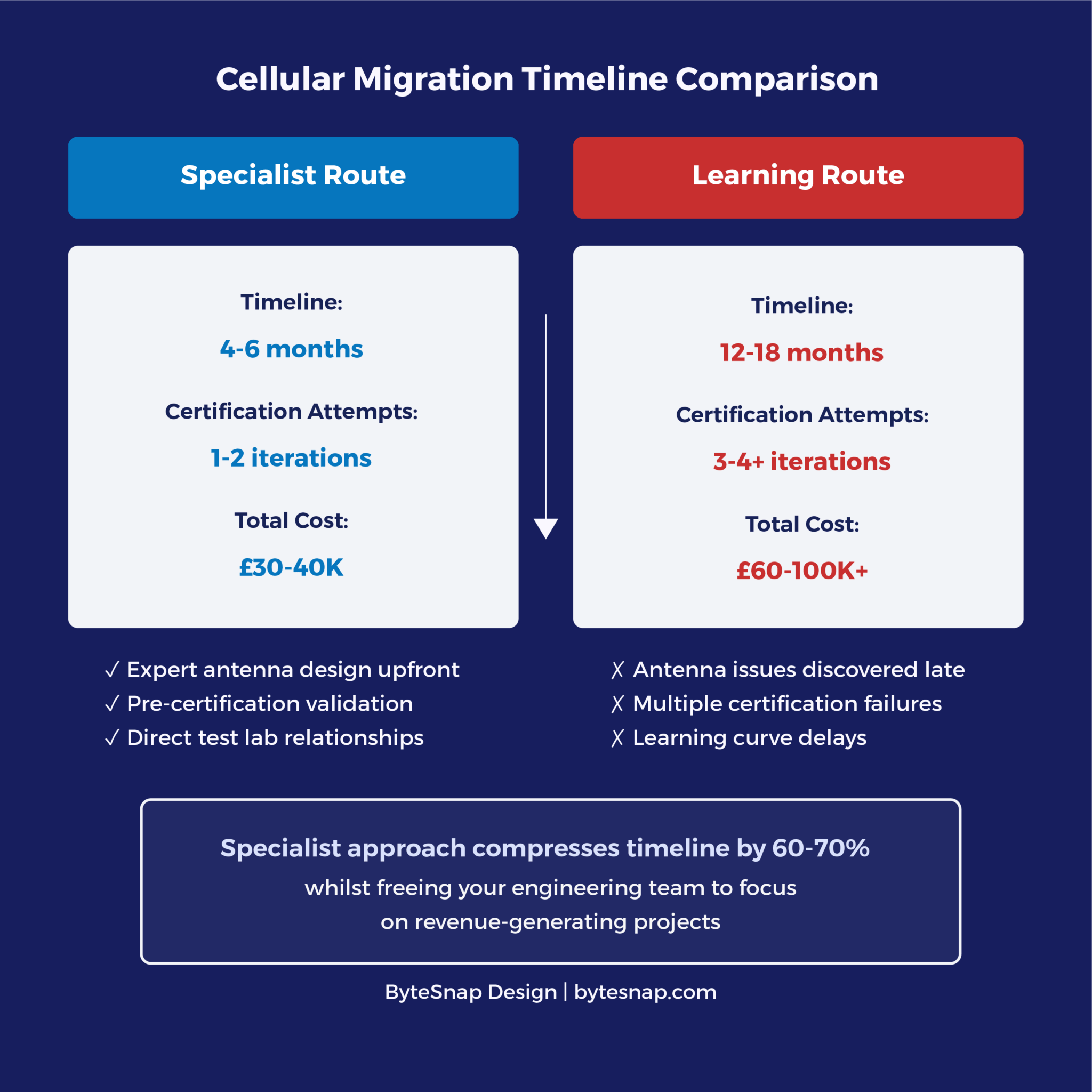
ByteSnap’s Cellular Migration Fast-Track service addresses this capability gap, compressing typical 12-18 month timelines to 4-6 months by providing the specialist RF design, embedded Linux modem driver expertise, and certification navigation that manufacturers need but don’t maintain in-house.
Where "Pin-Compatible" Falls Apart
Let me walk you through what actually happens…
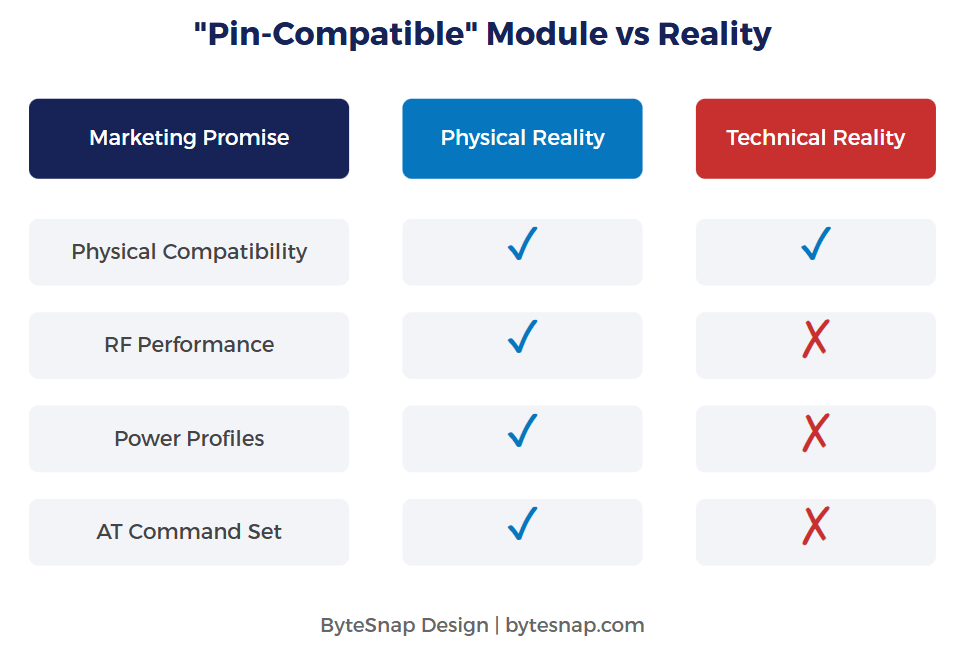
Your purchasing team finds a module advertised as pin-compatible with your existing design. The datasheet confirms identical physical footprint, matching voltage requirements, same UART interfaces. Six weeks for PCB revision, another six for testing.
Project approved.
Three months later, your prototypes exhibit terrible RF performance. Range has dropped by 40%. Connection reliability is inconsistent. Your engineer spends two weeks checking everything, PCB layout, component values, power supply. Everything looks correct.
But the problem isn’t where most embedded engineers expect to find it.
Your original 2G module operated at 900 MHz and 2100 MHz. Your new LTE-M module needs 800 MHz, 1800 MHz, and 2600 MHz for UK networks. That antenna you reused? It’s optimised for different frequencies entirely. The impedance matching that worked perfectly before now creates significant power loss across the new bands.
Where RF expertise comes in
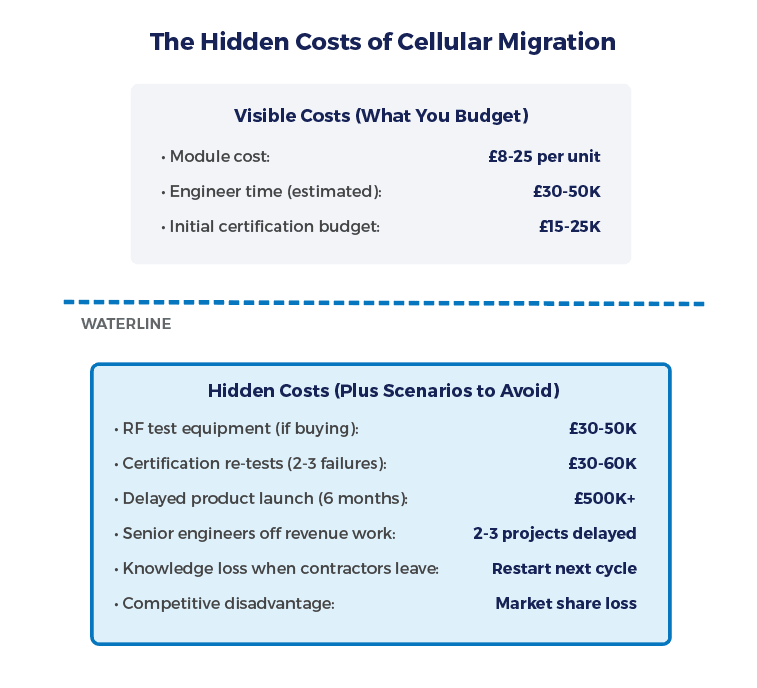
Fixing this requires specialist RF design expertise most embedded teams don’t maintain in-house. You need vector network analysers (£30-50K if you’re buying), Smith chart analysis capabilities, and probably conversations with antenna manufacturers. We’ve seen this single issue extend projects by 2-4 months whilst teams either acquire the knowledge or find specialists.
The power supply presents another surprise. Your original module drew 2A peak current during transmission. The replacement draws 2.8A. In battery-powered devices without adequate supply margin, this causes brown-outs during transmission bursts. You only discover this during extended field testing, not on the bench.
Then there’s the AT command set, the software interface for controlling cellular modems. These vary between manufacturers and even between module families from the same vendor. Your existing firmware might need substantial rework for authentication sequences, power-saving modes, and error handling. It’s not impossible work, but it requires somebody who understands cellular modem behaviour on a detailed level.
Updating embedded firmware to handle new AT command sets whilst maintaining backward compatibility requires systematic modem driver knowledge and regression testing across deployment scenarios
Certification: Where Good Plans Go to Die
You’ve sorted the antenna. Power supply’s been beefed up. Firmware handles the new command set. It feels like time to get into production – a three-month window, maybe four including manufacturing setup.
Except PTCRB certification for operating on commercial cellular networks isn’t a rubber stamp. It’s comprehensive test of your device’s RF performance, protocol implementation, and how it interacts with the network. Test labs look at whether you’ve actually met 3GPP specifications, whether your device might cause interference, how it handles edge cases like weak signals or network handovers.
Most devices fail first attempt. Not because engineering teams are incompetent, but because cellular protocols have hundreds of edge cases that general embedded teams haven’t encountered before.
Each failure means design modifications and complete re-testing.
A first certification attempt runs between £15k and £25k depending on the lab and the device.
If you fail, you’re stuck debugging RF performance at band edges or fixing protocol errors during attach procedures.
Six to twelve weeks later, you resubmit for another £8k to £15k. Two failures can double your budget and add six months to your launch.
As an NXP Gold Partner with direct relationships to the test labs, we see the failure patterns before they happen.
When we’re designing your RF section, we already know what the lab will test. When we’re implementing protocol handlers, we’ve debugged those exact attach sequence errors dozens of times.
The difference between specialist and generalist teams is most obvious here. Specialists typically pass on the first or second attempt because the hardware is designed with certification requirements in mind.
Generalist teams often learn these requirements through expensive failures.
Resources Don't Equal Capability
The instinctive management response to a stalled project is adding more people. You hire a contractor or assign another internal engineer, assuming more heads mean faster progress.
This works for computational problems, but it fails for capability gaps in specialised domains. Cellular connectivity sits where RF engineering, embedded software, telecommunications protocols, and regulatory compliance intersect.
You can’t become productive in that intersection by reading a datasheet for a few weeks.
Consider what “cellular migration expertise” actually requires. Your hardware team handles PCB layout and component selection, but cellular products need RF specialists for antenna performance.
Your embedded software team writes excellent firmware, but cellular modems require deep embedded Linux kernel knowledge for proper driver implementation and power management.
Your systems engineer manages integration testing, but cellular certification needs someone who understands PTCRB/GCF processes and relationships with test labs.
Few manufacturers maintain this complete spectrum in-house. If you do one cellular migration every three years, permanent staff for these specialised roles makes little economic sense.
But when that migration becomes urgent because networks are shutting down, the capability gap becomes very obvious, very quickly.
Even if you successfully navigate a one-off migration by having internal engineers learn on the fly, the team often disbands once the product launches. Three years later, when 5G RedCap emerges, you’re starting from scratch again.
Manufacturers who handle technology transitions smoothly don’t rebuild their knowledge every cycle. They maintain relationships with specialist partners who develop this expertise continuously.
What Your Stalled Project Actually Reveals
If your migration has been “in progress” for a year with limited results, you’re seeing the impact of over-specialisation.
Your engineers are capable and have delivered successful products before. But cellular connectivity is outside their core domain, and the learning curve is consuming more time than anticipated.
This isn’t a failure of your team; it’s a recognition that domain expertise matters. A brilliant motor control engineer won’t automatically excel at cellular modem power optimisation. An expert in sensor fusion isn’t necessarily qualified to debug PTCRB certification failures.
Different problems require different specialist knowledge. We see this pattern constantly:
- Industrial manufacturers with superb mechanical engineering often struggle with embedded electronics.
- Electronics firms with excellent analogue design hit walls on ATEX certification for hazardous environments.
- Medical device companies with deep regulatory knowledge get stuck on wireless approvals.
Problems arise when projects demand capabilities outside your core strength. While the instinctive response is building that capability internally, partnership models usually deliver better outcomes at a lower total cost for specialised domains that you only need occasionally.
Whilst Your Team Learns, What Happens to Your Roadmap?
Your senior engineers – the ones you need driving new product development – are currently deep in cellular modem datasheets trying to understand the trade-offs between PSM and eDRX.
This creates a substantial opportunity cost.
Every month your top engineers spend on these learning curves is a month not spent on the next product generation.
Your competitors have either completed their migrations or partnered with specialists to move faster. They are back to building differentiated products while you are still debugging antenna matching.
Component obsolescence isn’t a one-time event; research shows 88% of manufacturers face it at least annually.
Standards evolve, and networks upgrade. If each event consumes 18 months of your engineering time, you stay perpetually reactive.
Breaking this cycle requires a partnership where transitions are treated as routine, not a crisis.
How Specialist Partners Compress Timelines
When we engage on cellular migrations, the timeline typically drops to 4-6 months.
Not because the technical work becomes simpler, but because we’re applying proven patterns rather than learning as we go.
Our hardware team selects components knowing exactly which modules perform reliably in which applications. We’ve tested dozens of cellular modules across different use cases. The antenna design draws on a library of proven approaches for different enclosure types and frequency bands. The firmware leverages existing modem management code rather than starting from scratch. Certification follows established relationships with test labs who understand our design approach.
This accumulated expertise represents the real value. You’re not buying engineering hours. You’re buying capability that’s been refined across hundreds of projects and continuously maintained as technologies evolve.
The most successful client relationships extend beyond individual projects. Quarterly planning sessions identify upcoming technology transitions before they become urgent. Proactive obsolescence monitoring provides 12-18 month early warning on component lifecycle. Pre-qualified migration paths mean you’re never starting from zero.
This strategic approach transforms recurring technology crises into planned transitions. Instead of scrambling when critical components reach end-of-life, you’ve already evaluated alternatives, planned timelines, budgeted appropriately. Your engineering team stays focused on innovation rather than constant firefighting.
Next Steps: Moving Your Stalled Project Forward
Your stalled migration presents a choice: continue the current path and accept the risk of escalating costs, or engage a partner to compress the timeline and free your team for core work.
The decision centres on total cost, including the opportunity cost of delayed launches and the risk of repeated certification failures.
Most manufacturers find that a specialist partnership delivers better outcomes and much higher timeline certainty.
Book Your Cellular Migration Fast Track Assessment
IoT Triage and Cellular Migration FAQs
How long does a standard cellular migration take with ByteSnap Design?
Our Fast-Track service typically delivers production-ready hardware in 16 to 24 weeks. This compresses the standard 12-18 month internal learning curve by deploying specialist RF design and managed lab navigation from day one.
What is included in the Cellular Migration Assessment?
The initial 5-7 day assessment provides a full audit of your current PCBA, an antenna matching review, and a fixed-cost roadmap for hardware redesign and certification. This phase identifies “The Certification Wall” hurdles before incurring expensive lab fees.
Can you help if our product has already failed radiated emissions testing?
Yes. Our Cellular Migration Service is specifically designed for products that have stalled due to certification failures. We provide rapid RF debugging and antenna re-matching to recover your production schedule.
Do you handle the final network carrier certifications (PTCRB/GCF)?
While we are not a test house, we provide full lab navigation. We manage the technical construction file, coordinate with the labs, and provide the engineering support required to ensure your production-ready hardware passes certification.
Will we need a total enclosure redesign for 4G/5G?
In many cases, no. Our specialist antenna engineering focus is on maintaining your existing form factor while optimising internal PCB layouts to handle the increased complexity of 4G and 5G signal integrity.

Dan is a hardware engineer at ByteSnap Design with a background in test equipment design. He specialises in PCB design, schematic design, ATEX, and compliance work and has been involved in a range of projects spanning cellular migration, IoT and industrial electronics since joining the team in 2022.
Outside of engineering, Dan is a stand-up comedy and music enthusiast and is always open to new listening recommendations.
Further Reading
- Ofcom: 2G and 3G Network Sunsets https://www.ofcom.org.uk/phones-telecoms-and-internet/advice-for-consumers/advice/3g-switch-off
- European Commission: The Cyber Resilience Act (CRA): https://digital-strategy.ec.europa.eu/en/policies/cyber-resilience-act
GSMA: LTE-M and NB-IoT Deployment Map: https://www.gsma.com/iot/deployment-map/