Fast Facts: Embedded Wireless Design 2026
Q: Is Bluetooth 6 available for industrial applications in 2026?
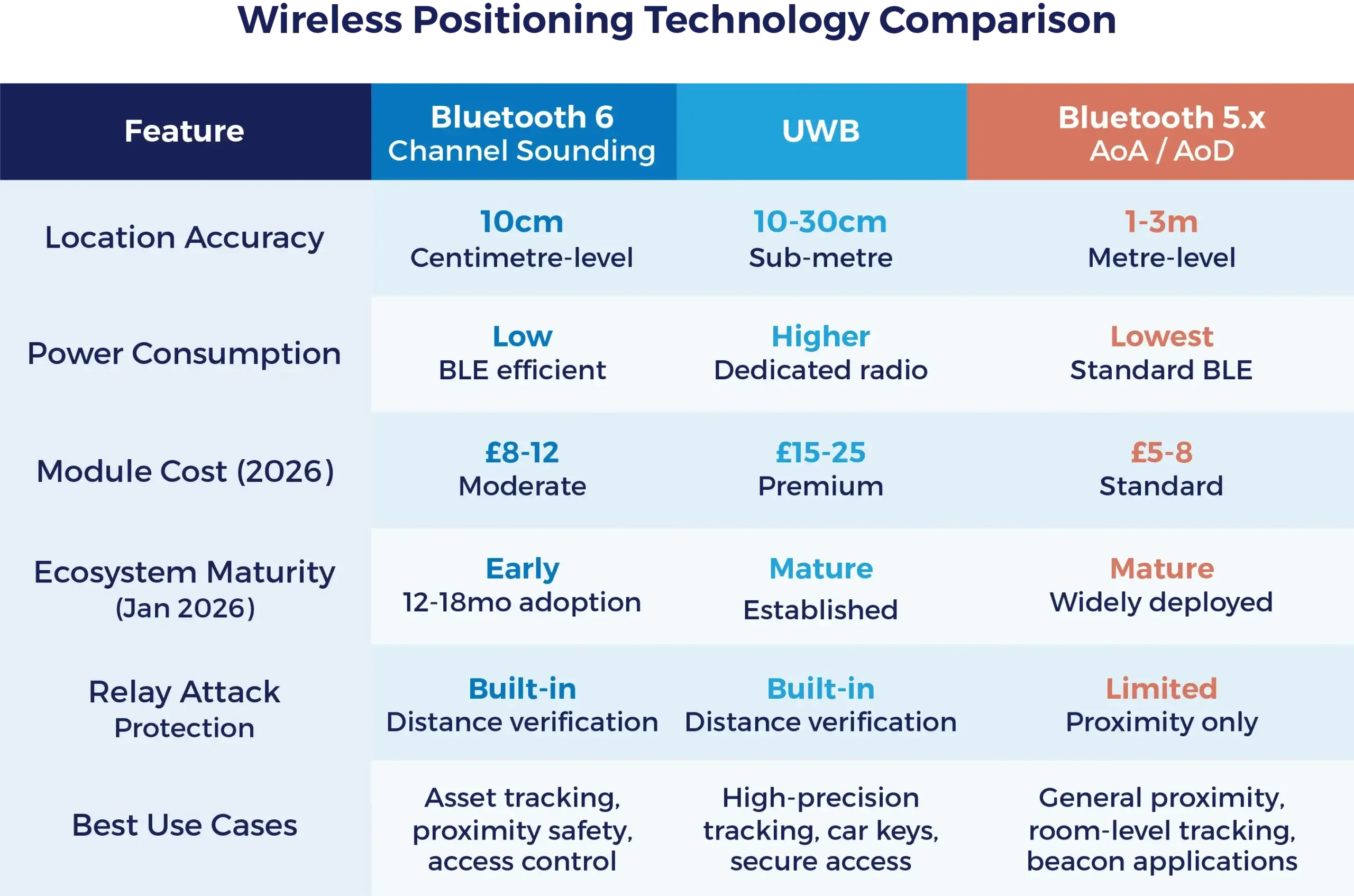
A: Yes. Bluetooth 6 chipsets began shipping in early 2025, with Channel Sounding technology offering centimetre-level location accuracy (10cm precision). Industrial applications in asset tracking and proximity-based safety systems can deploy Bluetooth 6 in 2026, though ecosystem adoption requires both devices to support the standard.
Q: Should I design with 5G RedCap for IoT products launching in 2026?
A: For most applications, no. 5G RedCap requires 5G Standalone network infrastructure (limited availability), costs 3x more than LTE-M modules (~£40 vs ~£14), and has incomplete roaming support. RedCap makes sense for industrial automation in private 5G environments or applications requiring higher bandwidth than LTE-M provides. For general IoT deployments, LTE-M/NB-IoT remains the practical choice in 2026.
Q: What CE-Cyber compliance requirements affect wireless products now?
A: The CE-Cyber Delegated Act under the Radio Directive has been mandatory since August 2025 for all wireless products sold in the EU. Non-compliance prevents CE marking and carries fines up to 2.5% of annual revenue. Requirements include risk assessments, device authentication, secure boot, and OTA update mechanisms, not just RF testing.
Q: How does edge AI reduce power consumption in wireless devices?
A: Edge AI processes data locally rather than transmitting raw sensor data wirelessly. In predictive maintenance sensors, this can reduce wireless transmissions by 90%, extending battery life from months to years. The power savings depend on transmission frequency, data rates, and AI model efficiency. Local inference must consume less power than constant wireless communication would require.
Q: Are Phase Change Memory microcontrollers ready for production designs in 2026?
A: Not for most applications. STMicroelectronics' STM32V8 with embedded PCM entered production in H2 2025, but availability is initially limited to automotive applications. General-purpose microcontrollers with PCM won't reach mainstream adoption until 2027-2028. PCM enables 2-4x larger memory capacity than conventional flash, but remains an emerging technology in 2026.
Embedded Wireless Design 2026 Trends: Separating Vendor Promises from Engineering Reality
Should you specify 5G RedCap for industrial IoT products launching in 2026?
The answer exposes the gap between vendor roadmaps and deployment reality.
Based on our project work across ATEX Zone 0 sensors, industrial IoT devices, and regulatory-compliant systems, here are five specific predictions about embedded wireless design in 2026 from our engineering team.
Prediction 1: Bluetooth 6 Channel Sounding Will Enable Industrial Proximity Applications Without UWB Investment
Look out for Bluetooth 6 Channel Sounding reaching commercial deployment in industrial settings throughout 2026. The technology offers centimetre-level positioning accuracy (10cm) without requiring Ultra-Wideband infrastructure investment. Warehouse asset tracking, proximity-based safety systems, and access control applications look likely to adopt Channel Sounding as chipset availability expands.
Channel Sounding’s combination of Phase-Based Ranging and Round-Trip Timing approaches UWB precision at a fraction of the power consumption and cost. This will prove particularly attractive where UWB’s infrastructure requirements or power demands have blocked deployment.
The Engineering Reality
Ecosystem adoption will follow a 12 to 18-month maturation curve. Both communication endpoints must support Channel Sounding to benefit from precision positioning, limiting initial deployments to applications with controlled infrastructure.
Three adoption patterns are emerging: industrial asset tracking for real-time tool and equipment location without UWB anchor networks, proximity-based machine safety systems for accurate geofencing around hazardous areas, and automotive access control implementations adopting Channel Sounding’s built-in relay attack protection.
Our Recommendation
Specify Bluetooth 6-channel sounding for battery-powered ATEX devices requiring 10-year life where UWB’s power consumption exceeds budgets, systems with existing Bluetooth infrastructure where adding precise positioning enhances functionality, and access control systems where relay attack protection justifies the upgrade.
For metre-level accuracy requirements, Bluetooth 5.x with Angle of Arrival or Angle of Departure remains adequate with mature ecosystem support.
Prediction 2: 5G RedCap Deployment Will Remain Limited to Private Networks and Premium Applications
Expect 5G RedCap adoption to concentrate in three narrow segments: private industrial 5G networks, wearables requiring Voice over NR capability, and video-enabled IoT applications. Mainstream industrial IoT adoption looks unlikely due to infrastructure limitations, cost premiums, and incomplete ecosystem maturity. RedCap will likely represent less than 5% of wireless connectivity specifications for products launching in 2026.
Deployment Barriers
Three significant barriers will constrain adoption:
- RedCap requires 5G Standalone infrastructure which UK and European operators continue rolling out, creating geographic coverage gaps.
- Module costs will remain at approximately £40 compared to £14 for LTE-M equivalents, a 3x premium impacting product economics.
- Certification complexity adds development time compared to straightforward LTE processes.
Real traction will emerge in private 5G industrial networks where factories leverage RedCap for automated guided vehicles and production monitoring. Wearables needing independent voice connectivity and video-enabled inspection cameras represent the other adoption categories.
Enhanced RedCap (eRedCap), arriving late 2026, targets 10 Mbps data rates with improved power efficiency, aiming to replace LTE Cat-1 devices. This variant looks set to gain adoption momentum faster than standard RedCap.
Our Recommendation
For clients with 3 to 5-year product lifecycles, specify LTE-M or Cat-M1 connectivity now with modular hardware design allowing future RedCap upgrades when the ecosystem matures. Products launching in 2026 will succeed by prioritising connectivity that works everywhere over cutting-edge specifications with limited coverage.
Prediction 3: CE-Cyber Compliance Will Drive Security-by-Design as Standard Practice
2026 marks the transition from CE-Cyber compliance as retrofit challenge to standard design practice.
With the Cyber Resilience Act (CRA) arriving in 12 months, 2026 becomes the critical planning year for ALL connected products, not just wireless devices. Businesses treating CRA as a 2027 problem will miss launch windows, due to inadequate compliance preparation time.
Compliance – The Reality
Risk assessment requirements continue catching teams unprepared. Threat modelling demands documented analysis following frameworks like IEC 62443, rather than simple pass/fail testing. Certificate management, device authentication, and secure boot implementations add around £3 to £8 per unit depending on complexity.
Our Recommendation
Begin every wireless project with security architecture definition rather than treating compliance as pre-certification activity.
Key elements:
- secure boot using verified bootloader with cryptographic signature checking
- OTA update mechanism with authentication and rollback capability
- threat model documented following IEC 62443
- certificate management strategy for device identity
- vulnerability disclosure process with response timelines
- penetration testing budget of £5,000 to £15,000 per product variant.
Prediction 4: Edge AI Will Succeed Only When Properly Optimised for Power Budgets
Edge AI adoption will accelerate throughout 2026, but many implementations will fail at delivering promised power savings.
A clear divide will emerge between properly optimised architectures achieving 10x battery life improvements and poorly implemented solutions that actually increase power consumption versus traditional approaches.
Successful implementations in predictive maintenance sensors will deliver 90% reductions in wireless transmissions. Traditional approaches sampling sensors continuously and transmitting data for cloud analysis drain batteries rapidly. Edge AI processes sensor data locally, transmitting only when anomalies occur.
Components like STMicroelectronics’ ISM6HG256X integrating motion sensors with machine learning cores look set to gain traction. By combining sensing with embedded inference, these devices eliminate multiple discrete sensors whilst reducing power consumption.
Qualcomm’s Ambient IoT Alliance collaboration will bring battery-free wireless sensors using energy harvesting to commercial deployment for logistics and asset-tracking throughout 2026.
Failure Pattern
Many edge AI implementations are likely to fail due to developers over-engineering AI model complexity. Models exceeding application requirements negate benefits through excessive processing overhead. Basic edge AI with per-minute inference can actually increase power consumption versus traditional hourly transmission approaches.
Our Recommendation
Run detailed power budget models before committing to edge AI architectures. Success depends on transmission reduction substantially exceeding inference overhead. The winning approach matches AI model sophistication precisely to actual application requirements rather than maximising model capability.
Prediction 5: VS Code Will Dominate Whilst PCM Remains Automotive-Focused
Look for 80% of embedded wireless development to transition to VS Code-based toolchains by year-end as STMicroelectronics, Silicon Labs, and Microchip complete migrations from Eclipse environments. This shift will deliver measurable productivity improvements.
On the other hand, we see Phase Change Memory microcontrollers remaining limited to automotive applications throughout 2026, with general-purpose availability delayed until 2027 or 2028.
Toolchain Transformation
The VS Code migration delivers three measurable benefits:
- compilation times drop 30 to 40% compared to Eclipse predecessors
- new engineer onboarding shortens from two weeks to three days
- extensible plugin ecosystems enable custom linting and automated code analysis that shift quality left into development phases.
RISC-V adoption in wireless microcontrollers continues expanding. Platforms like Espressif’s ESP32-C6 and Raspberry Pi’s RP2350 bringing open instruction set architecture to mainstream applications offer increasingly attractive alternatives to traditional ARM implementations.
The open ISA approach matters particularly for high-volume industrial IoT products with long lifecycles, reducing dependency on single vendor roadmaps.
PCM Reality
Despite STMicroelectronics’ STM32V8 entering production in H2 2025, Phase Change Memory microcontrollers will remain automotive-focused throughout 2026. General-purpose microcontroller availability won’t arrive until 2027 or 2028.
For wireless projects launching in 2026, conventional flash-based microcontrollers remain the only practical choice.
Our Recommendation
Adopt VS Code-based development toolchains immediately for measurable productivity gains.
For projects requiring large code space or frequent firmware updates, track PCM developments whilst specifying proven flash technology for 2026 launches.
Our Technology Selection Framework for 2026
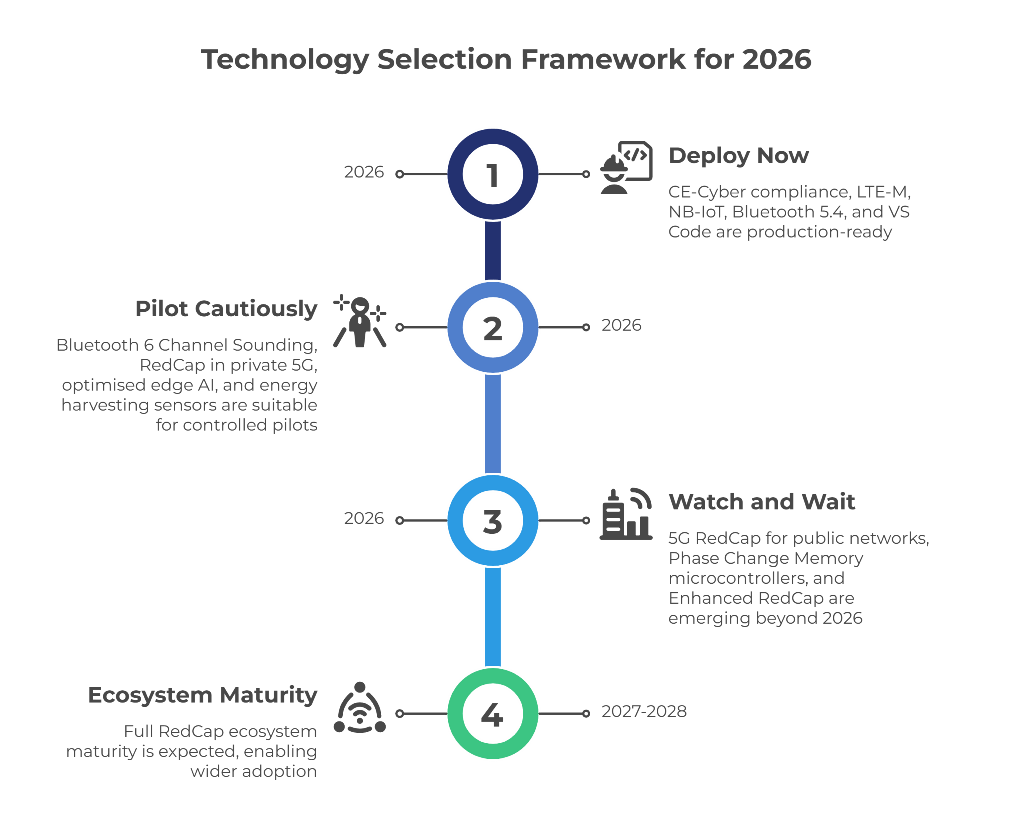
Technology maturity varies dramatically across embedded wireless options. Base your design decisions on what’s actually available now, not what’s promised in vendor roadmaps:
- Deploy now (production-ready) CE-Cyber compliance (mandatory), LTE-M and NB-IoT connectivity (mature ecosystem), Bluetooth 5.4 (established, reliable), VS Code development toolchains (proven productivity gains)
- Pilot cautiously (early adoption): Bluetooth 6 Channel Sounding (controlled endpoints), RedCap in private 5G networks (where infrastructure exists), optimised edge AI (with thorough power analysis), energy harvesting sensors (appropriate environments)
- Watch and wait (emerging beyond 2026): : 5G RedCap for public networks (coverage gaps), Phase Change Memory microcontrollers (automotive-only in 2026), Enhanced RedCap (arriving late 2026), full RedCap ecosystem maturity (2027-2028)
We’ve learned from hundreds of client projects that honest assessment of technology readiness delivers better outcomes than repeating vendor marketing claims.
When semiconductor vendors announce new wireless chipsets, ask yourself:
- Is silicon actually shipping?
- What are the real lead times?
- Are development tools mature enough for your timeline?
You’ll succeed with embedded wireless projects in 2026 and beyond by choosing technical realism over enthusiasm for emerging technologies.
Planning your wireless connectivity strategy for 2026?
Further Reading
Bluetooth 6.0 and Channel Sounding
- Bluetooth Core Specification 6.0 Technical Overview
- The New and Improved Bluetooth 6.0
- Bluetooth Channel Sounding Feature Overview
5G RedCap Deployment and Adoption
- 5G RedCap: Real Deployment Challenges and Benefits for IoT Devices –
- 5G RedCap: Unlocking Scalable IoT and FWA Innovation –
- 5G RedCap and the Future of IoT Connectivity
CE-Cyber Compliance and Radio Equipment Directive
- Cybersecurity Requirements for Radio Equipment Directive
- RED Cybersecurity Requirements Take Effect August 1, 2025
- CE-Cyber Delegated Act: What IoT Manufacturers Need to Do
Cyber Resilience Act (CRA)
Founded in 2008, ByteSnap Design is an award-winning embedded systems design consultancy, offering a comprehensive range of services across the electronic product development lifecycle.
A highly skilled team of over 40 hardware and software engineers, our expertise spans several sectors, including IoT, automotive, industrial, medical, and consumer electronics.
The engineering consultants on the ByteSnap Editorial Team share their knowledge and practical tips to help you streamline your product development and accelerate designs to market successfully.
With their deep technical expertise and practical experience, they aim to provide valuable insights and actionable tips to guide you through the complex world of electronic product design and development, to help you bring innovative, reliable, and secure electronic products to market quickly and cost-effectively.