
A considerable amount of annual UK revenue was at risk. Two of Securitas Technology’s best-selling personal alarm products had failed radio compliance testing, and they needed a design partner who could get a grip on a complex legacy RF system and deliver compliant products. They called ByteSnap Design.
At a Glance
- Client: Securitas Technology
- Profile: World-leading provider of integrated electronic security solutions, serving NHS sites, care homes and high-security establishments across the UK and internationally
- Size: Global organisation, 13,000+ employees across 40 countries
- Project vertical: Security / Healthcare & Critical Infrastructure
- Challenge: Legacy RF circuitry on two life-safety alarm products failed RED compliance testing, threatening considerable annual UK revenue and requiring a full RF redesign to return both to market.
- Solution: Full RF front-end redesign across the pendant transmitter, staff protection mobile device and expansion unit, with firmware development and on-site RED compliance testing support
- Services: Hardware Redesign, Firmware Development, RF Design & Optimisation, RED Compliance Support
- Impact: Full RED compliance across all three products; legal sale restored in the UK; protected revenue line; legacy product family given a viable future
Staff alarms in hospitals, care homes and other secure sites: why these products couldn’t afford to fail
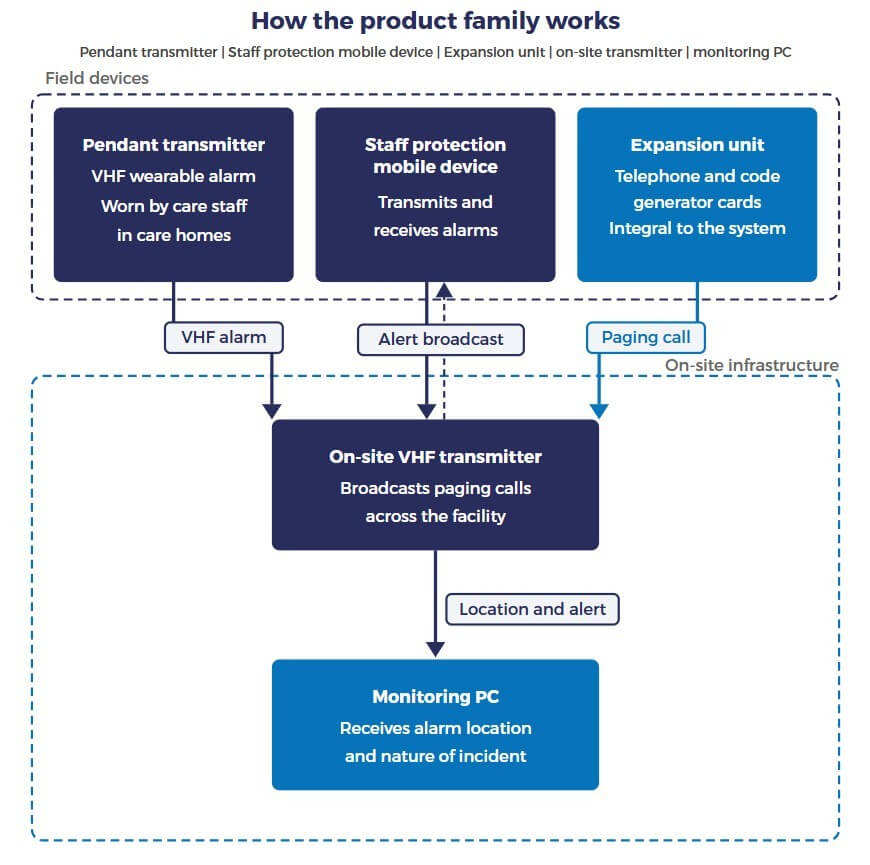
The pendant transmitter is a VHF device worn by care staff in care homes and NHS settings. The staff protection mobile device is used in high-security establishments: press the alarm button, and it transmits the user’s location and the nature of the incident to colleagues across the site. In some settings, these are life-critical devices, relied upon in secure hospitals and care homes across the UK and France.
Securitas Technology has been deploying and supporting products like these since the mid-1990s, serving NHS acute and mental health sites, high-security establishments and care homes.
Compliance issues putting considerable annual revenue at risk
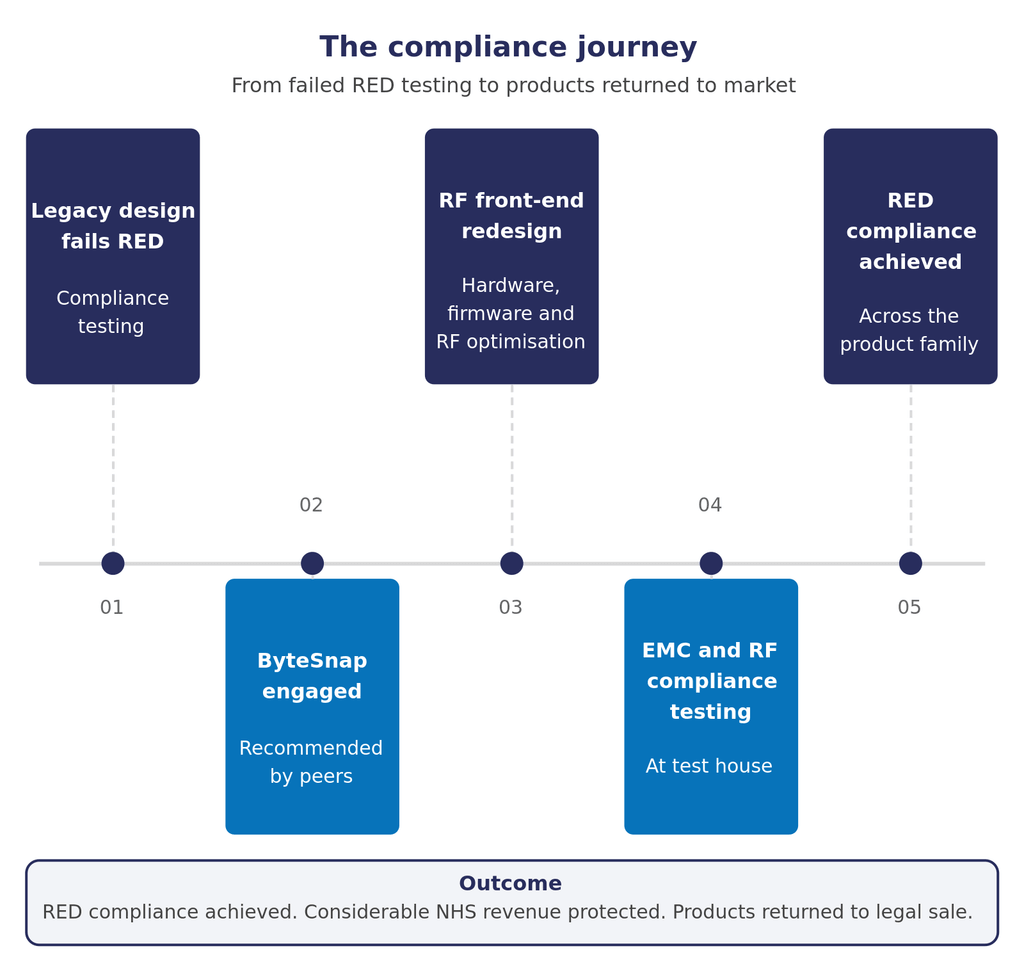
Compliance regulations had changed, and products that were once compliant no longer met the Radio Equipment Directive (RED). The original analogue RF circuitry, built from discrete components, failed on adjacent channel emissions. Without passing RED, neither product could legally be sold in the UK.
Colin Barnes, Technical Support Healthcare at Securitas Technology, had to make the commercial case internally to get the project moving. “I was told that if they’re not compliant, you will not be able to sell them legally in the UK,” he explains. “I had to speak to senior management to explain that having this issue now puts our revenue from this product at risk.” At the time, that revenue represented a considerable sum per annum through NHS clients. Once senior management understood the scale of it, the project went ahead.
The technical complexity was significant. Both products carried years of field history, a legacy architecture that needed to be understood rather than replaced, and firmware that required careful archaeology to locate and extend. Securitas Technology was looking to outsource this piece of design work, and came to ByteSnap Design on the recommendation of colleagues from another part of the business.
Full RF redesign, from legacy architecture to RED-compliant products
ByteSnap’s approach was to work within the existing architecture wherever possible. The PIC microcontroller platform was retained for cost reasons and compatibility with the existing codebase, and parts of the firmware were written in PIC assembly to preserve legacy behaviour precisely.
On the hardware side, ByteSnap carried out a full RF front-end redesign with specialist RF expertise brought in alongside the core engineering team. The discrete analogue circuitry was replaced with a new RF transceiver, and a new VHF transmitter board was designed for the pendant transmitter. That same circuit was then adapted as a daughterboard for the staff protection mobile device, giving both products a shared RF design, a shared bill of materials, and simpler stock management. The staff protection mobile device’s main board was also modified for additional RF improvements, including antenna matching and sensitivity optimisation.
The work extended to the expansion unit, the peripheral card housing that the staff protection mobile device depends on to function, bringing that into compliance alongside the other products.
RED compliance required multiple RF test and tune cycles, with ByteSnap and the RF specialist attending the test sessions in person across approximately two weeks of solid testing, giving valuable on-site technical support. For Colin, the moment the expansion unit cleared compliance was a standout. “There’d been so much effort, and a lot of stress. When they said, ‘Yes, it’s passed’, that was a really good feeling.”
The staff protection mobile device testing produced one of those moments that only happen in real-world engineering. During EMC testing, an electrostatic charge of around 10,000 volts was fired at the pager on an earthed steel table. The device locked up. The cause turned out to be the screw holes holding the transmit cover, providing an unintended path for the charge. The fix was rubber plugs – proper, specified, production-grade rubber plugs – now a standard part of the build. Entirely unforeseen, resolved on the spot.
Adding the new circuitry increased power consumption against the original discrete design. ByteSnap tuned hardware and firmware to bring consumption back within the agreed threshold, then validated battery life through dedicated testing. Weekly progress meetings kept the client informed throughout, with costs managed transparently and any budget freed up on one product redeployed to the next.
Products back on the market. Revenue protected. Confidence restored.
Both products passed RED compliance and returned to legal sale in the UK. The shared RF design simplified manufacturing, and production was adapted to the new specification without time penalties. The expansion unit passed alongside them.
“It’s given us the confidence to sell the product knowing it meets RED compliance standards,” says Colin. “It’s given our sales team confidence to go out and sell. We have a legal, safe product for use.”
ByteSnap and Securitas Technology continue to work together across the wider product family of radio communications solutions.