
⏩ TL;DR: DRAM shortage affecting embedded systems designs
The DRAM shortage is not a blip. AI data centres have consumed manufacturing capacity that the rest of the electronics industry relied on, and the structural imbalance will not resolve before 2027 at the earliest. If your product depends on DDR4 or DDR5, your bill of materials cost and your lead times are both under pressure right now.While this article focuses on the newer DRAM lines, older versions of DRAM are also affected whilst their manufacturers follow where the most money is - which is in creating the latest versions of DRAM for data centres. The fix is not simply to find more stock. For embedded systems manufacturers, the most effective responses are: audit what your BOM actually depends on, look hard at whether your software footprint is making the problem worse than it needs to be, and plan procurement 12 to 18 months out rather than on a rolling eight-week basis. ByteSnap Design can help with all three.
Table of Contents
When 1KB was enough
I had a Sinclair ZX81 when I was twelve. It had 1KB of RAM.
Not one gigabyte.
Not one megabyte.
One kilobyte, which is 1,024 bytes, or roughly what you could write on a single side of A4.
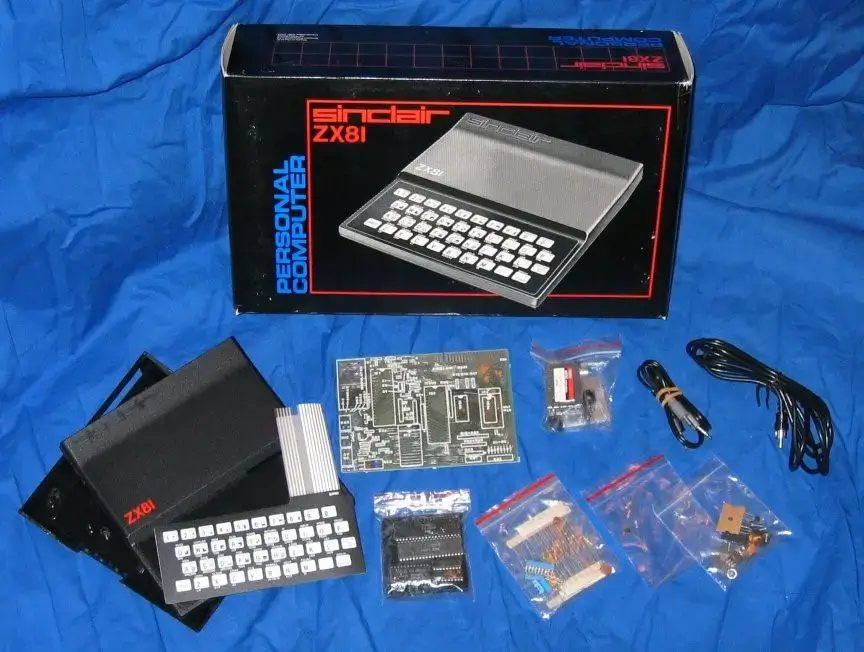
People still managed to write games on it. I remember the RAM pack, a chunky 16KB expansion that plugged into the back and wobbled notoriously. If it shifted while you were mid-program, everything went.
Then in 1982 came the Zx Spectrum: 16KB in the entry model and 48KB the version everyone actually wanted.
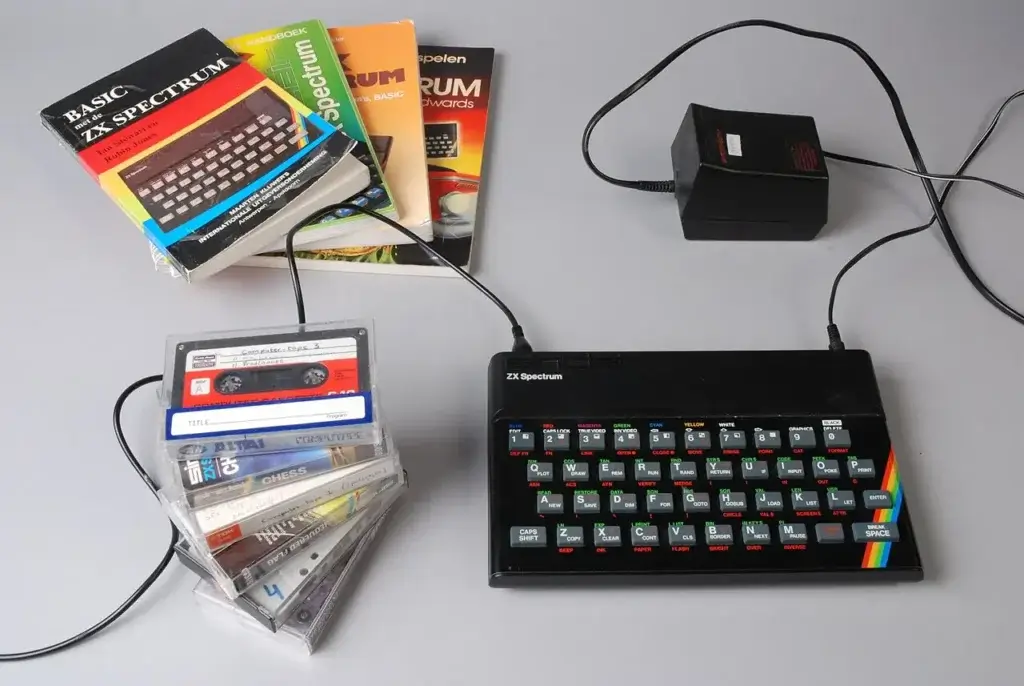
It cost about the equivalent of £1,000 in today’s money for the 48KB version. Expensive. Precious. Every byte counted.
I think about those machines a lot right now.
Because in 2026, we are watching the embedded systems industry discover, rather painfully, that memory is not infinite after all.
We had decades of it getting cheaper, faster and easier to access.
Engineers got used to it. Software got… comfortable.
And now we have DRAMageddon, and some of that comfort is costing manufacturers real money.
What is actually driving the DRAM shortage?
This is not a repeat of the 2020-23 supply chain crisis, though it rhymes. That was a broad shock caused by pandemic disruption and demand whiplash across dozens of component categories. This one is more specific, and in some ways more structural.
The core problem: AI data centres need enormous quantities of High Bandwidth Memory (HBM), a stacked DRAM technology used in GPU accelerators. Producing one gigabyte of HBM consumes roughly three times the wafer capacity of standard DDR5.
The three companies that control around 95% of global DRAM production, Samsung, SK Hynix and Micron, have been reallocating that capacity accordingly. Every wafer going to HBM is a wafer not going to the DDR4 or DDR5 that your embedded product needs.
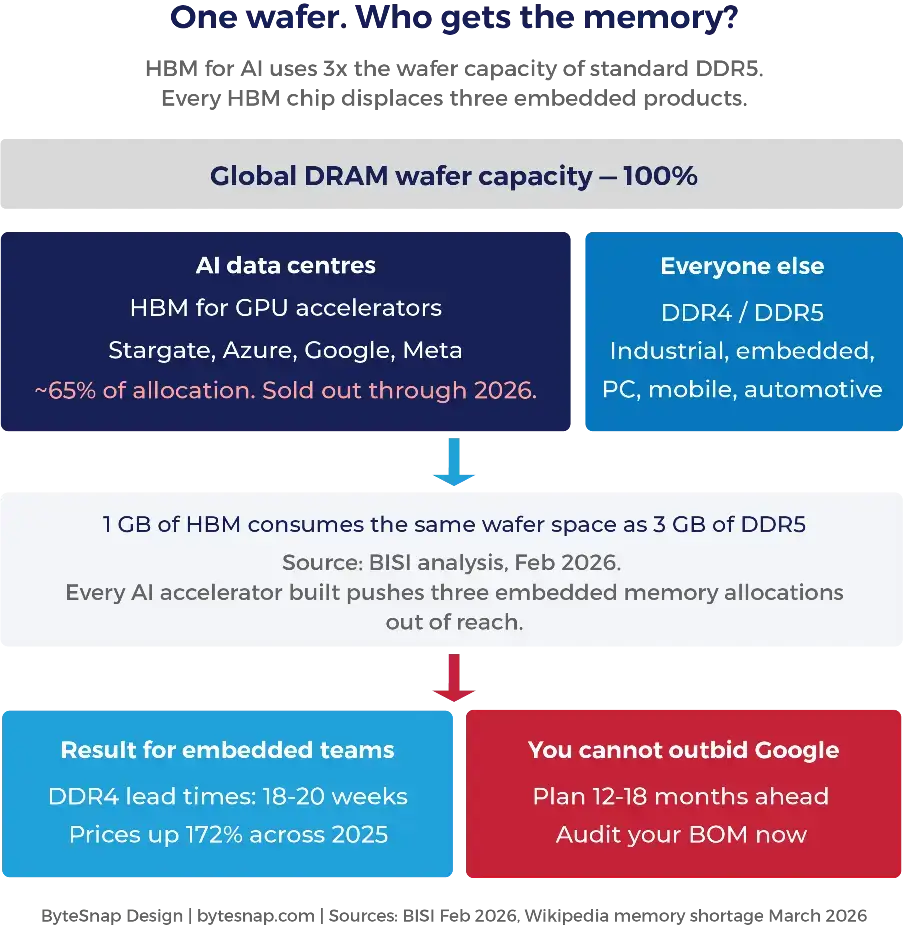
By February 2026, SK Hynix had secured demand for its entire year’s RAM production. DRAM prices rose approximately 172% across 2025. Lead times that used to sit at around eight weeks are now running to 18-20 weeks or beyond in some cases. (Sources: Wikipedia global memory shortage article, March 2026; EBV Elektronik distributor alerts)
The impact on embedded and industrial systems is particularly sharp.
Consumer electronics can absorb a price hike and pass it through.
High-volume embedded products on thin margins, EV chargers, industrial controllers, medical devices, cannot do that as easily. And unlike the broader consumer DRAM market, embedded teams running DDR4-dependent platforms have very limited ability to pivot quickly.
Long product lifecycles, validated hardware platforms and certified firmware all work against rapid redesign.
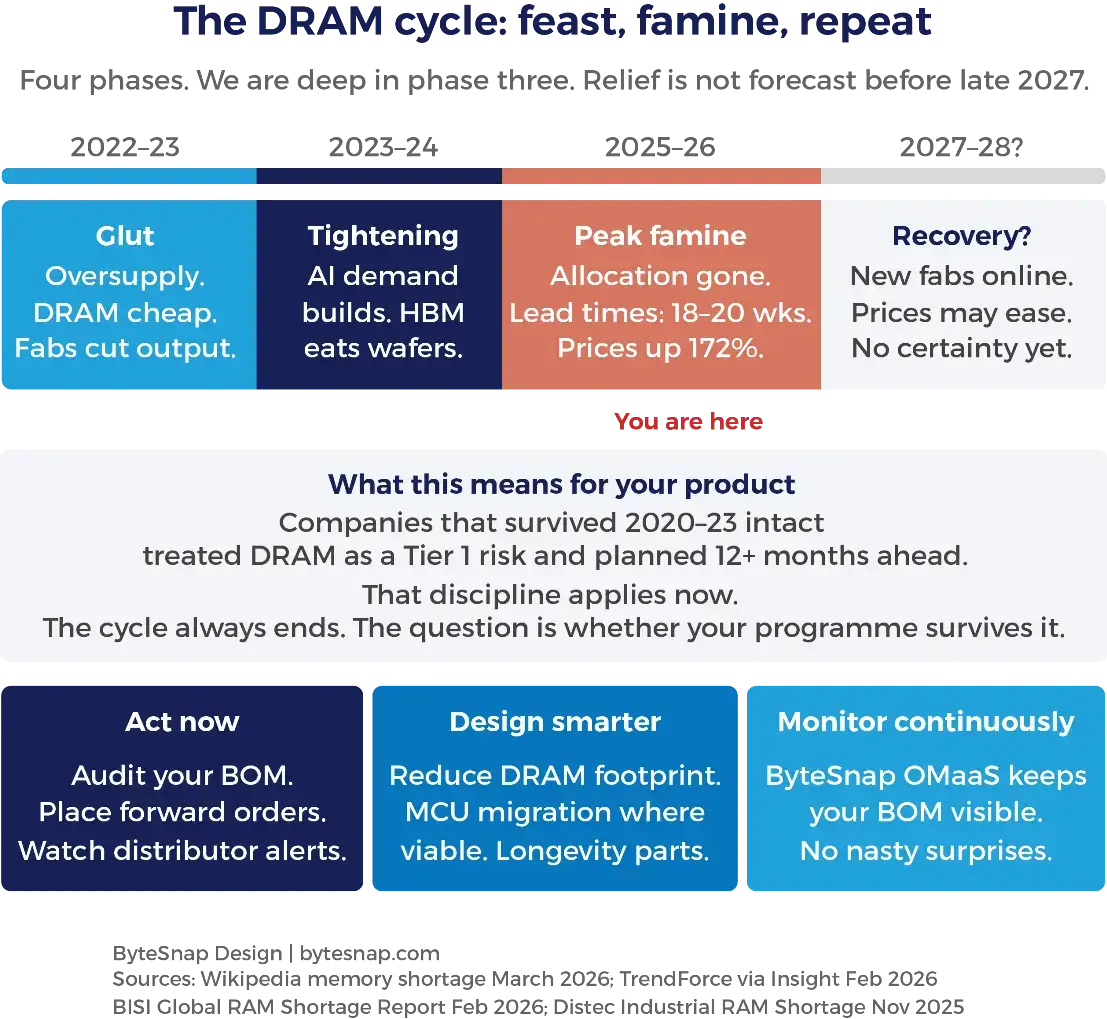
I heard the frustration at Embedded World this year from MCU and PMIC vendors whose customers had simply stopped buying. Not because they didn’t want to build, but because they couldn’t get DRAM.
One missing line in a 100-line BOM stops the whole build. Every other component on that list is dead stock until the DRAM arrives.
Is DDR5 the answer? Not necessarily...
A common piece of advice circulating right now is to move from DDR4 to DDR5. The logic being that DDR5 is newer and therefore has more available production capacity. The honest answer is: it depends, and the window is closing.
Some microcontroller vendors are updating their DRAM controllers to support DDR5 specifically because DDR4 is now in worse shape. In the near term, some DDR5 variants are more accessible. But fabs chase the money, and as more designers migrate to DDR5, pressure there is building too.
TrendForce projected DDR5 server prices rising more than 60% in Q1 2026 alone. Samsung has also flagged EOL intentions for some DDR4 lines, which has accelerated the DDR4 price spike without making DDR5 reliably available.
If switching to DDR5 makes sense for your roadmap anyway, now is a reasonable time to make that move where you can. But don't assume it's a safe haven. Get advice specific to your platform before committing to a redesign on that basis.
Can you engineer your way out of this?
Partly, yes. And this is where I think the Embedded World has an angle that the rest of the electronics industry does not.
Go back to the ZX Spectrum. Developers wrote extraordinary things within extraordinary constraints. That discipline did not vanish; it just went dormant during twenty years of cheap, abundant memory.
DRAMageddon is, in one uncomfortable sense, a prompt to ask whether your next product genuinely needs a Linux-class platform with a gigabyte or more of DRAM, or whether a leaner RTOS on a capable microcontroller would do the same job with a fraction of the memory dependency.
That is not always possible. Video and imaging applications need large frame buffers. Complex connectivity stacks have real memory requirements.
I am not suggesting everyone strip back to bare metal. But there are applications - EV charging is one we have worked on directly - where migrating from a DRAM-heavy embedded Linux implementation to a microcontroller-based platform is genuinely viable. Less exposure to DRAM spot pricing, better long-term component availability, often lower BOM cost overall.
For new designs, the most useful thing you can do is think about DRAM dependency at the architecture stage rather than the procurement stage. If you design in multiple viable memory options from the start, you are less exposed when one goes short.
The catch with DRAM is that it is a commodity, so all sources tend to be affected simultaneously. But choosing parts on a vendor's longevity programme, rather than the cheapest consumer-grade SKU, at least gives you some protection against obsolescence riding alongside the shortage.
Keeping production moving
During the 2020-23 supply chain crisis, we helped a high-volume client keep production moving by flipping the normal design sequence.
Instead of designing the product and then sourcing components, they identified the parts available, secured stock first, and then we designed around what they had. For a company building at 70,000 units per year, that was the only option.
The cash flow risk is real, but so was the risk of having nothing to ship.
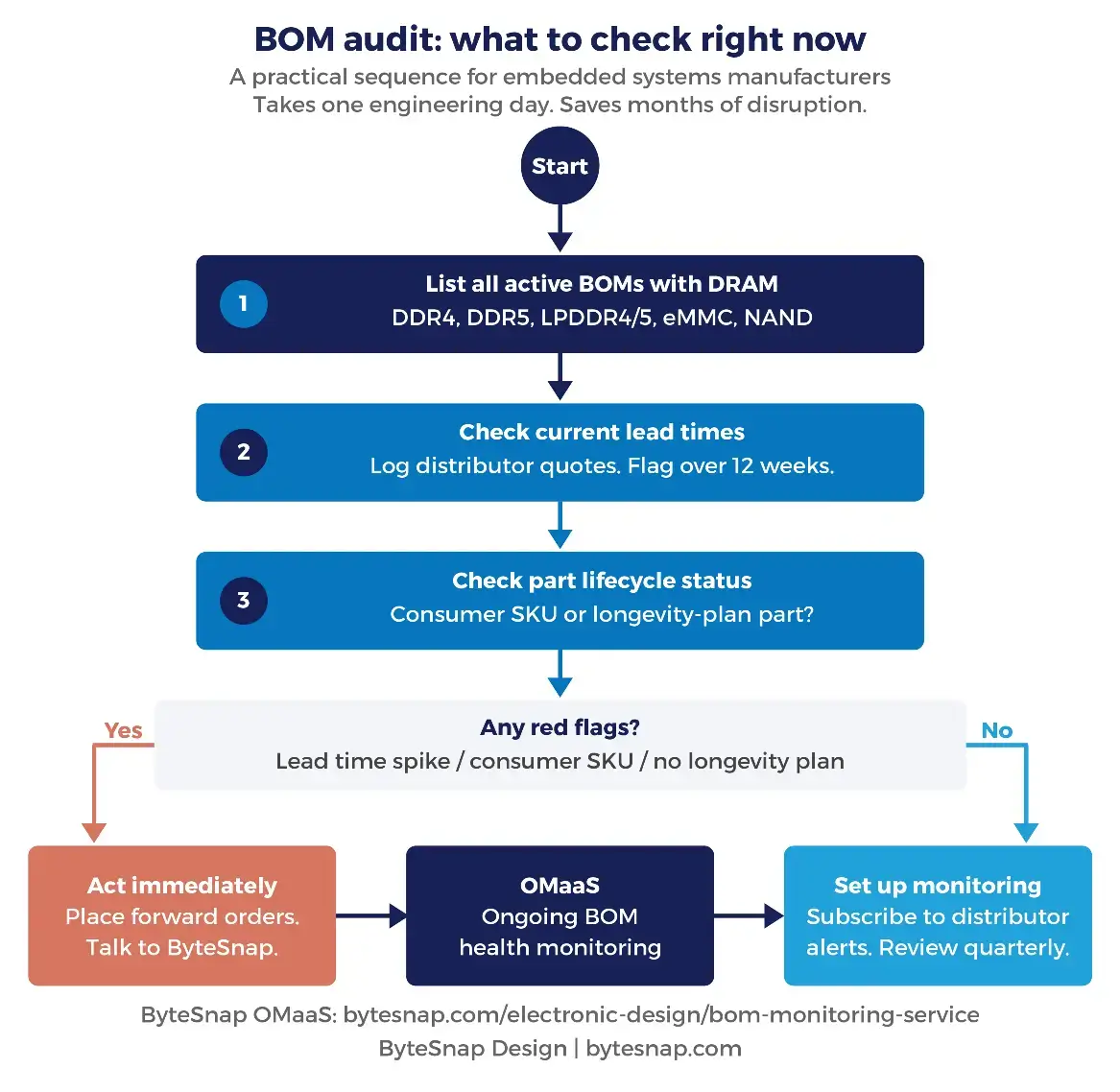
What a quick BOM audit tells you right now
If you aren’t sure how exposed your current products are, a BOM audit is the fastest way to find out.
Not a full redesign review, just a pass through your active BOMs looking at lead times, pricing trends and lifecycle status on memory components.
Specifically, check:
- Which of your products use DDR4?
- What volumes are you building at?
- What are the current lead times from your distributors?
- Are your memory parts on a consumer-grade SKU or a longevity-plan variant?
- Have any of your memory parts had quiet allocation notices from your distribution contacts, the kind where lead times creep from eight weeks to sixteen without a formal announcement?
That last one is the signal that matters most.
By the time a shortage is public knowledge, the available allocation has already been taken.
The engineers and teams who got through the 2020-23 crisis best were the ones who acted on distributor intelligence several months before the headlines appeared.
EBV Elektronik, for example, have been circulating lead time and pricing data on the DRAM situation since 2025. If you are on distributor alert lists and watching those signals, you are not flying blind.
How ByteSnap Design can help
We can support you in a few specific ways depending on where you are.
If you want ongoing visibility of your BOM’s health, rather than finding out about component risks when a production line stops, our OMaaS (Obsolescence Management as a Service) does exactly that.
We monitor your BOM continuously, assess the impact of any status or lifecycle changes, and flag the ones that actually need your attention. The point is to filter the noise so you only hear about things that matter to your product, not every minor distributor twitch.
If you are already in trouble, or you can see a specific platform becoming unviable because of DRAM costs or availability, our Design Rescue Service is built for that situation. We have experience redesigning products under time pressure, including switching microcontroller families and rewriting firmware to match. It is not quick or cheap, but it is considerably less expensive than halting production.
And if you are at the architecture stage on a new product and want to think through memory strategy before you commit, that is the right time to talk. The decisions made in the first few weeks of a design have a disproportionate effect on supply chain resilience for the life of the product.
Your next step takes an hour. Doing nothing could cost months.
FAQs
How long is the DRAM shortage likely to last?
Most credible analyst forecasts put meaningful supply relief no earlier than late 2027, when new fabrication capacity from Micron and SK Hynix is scheduled to come online. TrendForce and IDC both flag that AI infrastructure demand is structural rather than cyclical, meaning even when new capacity arrives, it may not all flow to standard DDR4 and DDR5 for embedded applications. Plan your procurement and product roadmap on the assumption that conditions stay tight through 2026 and most of 2027.
Should I switch from DDR4 to DDR5 now?
It depends on your platform. Some microcontroller vendors are adding DDR5 controller support specifically because DDR4 availability has deteriorated. In the near term, some DDR5 variants have better lead times. But DDR5 pricing is also under significant pressure, and a hardware redesign to change memory standard is not a short project. Get specific advice for your platform before treating DDR5 as a guaranteed safe move. For new designs starting now, DDR5 is probably the right default where your SoC or MCU supports it.
What are the vendor red flags to watch for before a shortage hits?
Watch your distributor lead time data. The reliable signal is lead times creeping upward on quarterly updates before any formal allocation notice. EBV Elektronik and Astute Electronics both publish regular pricing and lead time trend data; if you are not subscribed to their alerts, you are behind the curve. A jump from eight weeks to fourteen weeks on a standard DRAM part is a meaningful warning. By the time it is 20 weeks, the allocation has already been absorbed by larger buyers.
Do I need to redesign my product if I can't get the DRAM?
Not necessarily right away, and it depends heavily on your volume and margin. For low-volume products, you can sometimes find allocation through specialist distributors at a premium and absorb the cost. For high-volume products building at tens of thousands of units annually, where a 20% increase in DRAM cost materially damages your margin, a redesign conversation is worth having sooner rather than later. The counterintuitive lesson from past supply crises is that the companies that acted early, even when the situation seemed manageable, came out best.
What is OMaaS and how does it relate to DRAM risk?
OMaaS is ByteSnap’s Obsolescence Management as a Service. We monitor your active BOMs continuously for component lifecycle and status changes, assess whether those changes have a real impact on your design, and alert you to the ones that do. In the context of DRAMageddon, that means tracking the specific memory parts in your products for lead time trends, EOL signals and allocation changes, and giving you enough notice to act rather than react. It is a monthly service, separate from any design or redesign work, and is available on products we did not originally design.

Dunstan is a chartered electronics engineer who has been providing embedded systems design, production and consultancy to businesses around the world for over 30 years.
Dunstan graduated from Cambridge University with a degree in electronics engineering in 1992. After working in the industry for several years, he co-founded multi-award-winning electronics engineering consultancy ByteSnap Design in 2008. He then went on to launch international EV charging design consultancy Versinetic during the 2020 global lockdown.
An experienced conference speaker domestically and internationally, Dunstan covers several areas of electronics product development, including IoT, integrated software design and complex project management.
In his spare time, Dunstan enjoys hiking and astronomy.
Further Reading
Wikipedia: https://en.wikipedia.org/wiki/2024%E2%80%93present_global_memory_supply_shortage
IDC. (2026, February): https://www.idc.com/resource-center/blog/global-memory-shortage-crisis-market-analysis-and-the-potential-impact-on-the-smartphone-and-pc-markets-in-2026/
TrendForce. (2026, February). Memory Price Outlook for 1Q26 Sharply Upgraded. Via Insight (2026):https://www.insight.com/en_US/campaigns/insight/2026-ram-shortage.html
BISI. (2026, January): https://bisi.org.uk/reports/global-ram-shortage-and-price-hikes-causes-consequences-and-market-outlook
Distec. (2025, November): https://www.distec.co.uk/navigating-the-2025-industrial-ram-shortage-what-our-customers-need-to-know/
Sourceability. (2025/2026): https://sourceability.com/post/the-memory-shortage-is-set-to-grow-through-2026
EBV Elektronik / Avnet (DRAM market intelligence and lead time alerts): https://my.avnet.com/ebv/resources/training-and-events/event/dont-panic-we-have-solutions/