⏩ TL;DR: Evaluating energy harvesting?
The question isn’t if but how much power do you need? Devices drawing microamps (sleep) with milliamp pulses (transmit) are viable. Devices requiring >10 mA continuous are not. Indoor light harvesting now delivers 32–38% efficiency (up from 15–25% in 2024). Hybrid systems (PV + vibration + thermoelectric) are today's baseline.
Battery replacement kills IIoT deployments.
Remote or hard-to-reach locations make maintenance costly – sometimes impossible.
Energy harvesting solves that. It captures ambient energy (vibration, heat, light, RF) to power devices indefinitely without battery swaps.
At ByteSnap Design, we specialise in low-power embedded software development and self-powered IIoT systems. We have extensive experience in developing complex electronics and software solutions, including projects that leverage energy harvesting to create self-sustaining IIoT devices. Our team of experts has a deep understanding of the technical complexities of integrating energy-harvesting technologies into IIoT systems, ensuring reliable and efficient operation.
This guide covers: feasibility calculations, wireless protocol comparisons (LoRaWAN, Zigbee, BLE, NB Cellular), a rail industry case study, and a May 2026 update on commercial perovskite PV and TENGs.
⏩ Key Takeaways
- Energy harvesting converts ambient energy (vibration, heat, light, RF) into electrical power – eliminating battery replacements.
- Successful devices operate at microamps (sleep) with milliamp pulses (transmit). Continuous milliamps are not feasible.
- Hybrid systems (PV + vibration + thermoelectric) are now the baseline for industrial environments.
- ByteSnap Design has deployed energy-harvesting LoRaWAN sensors in the rail industry (piezo + solar + wind, supercap backup).
Table of Contents
What is Energy Harvesting?
Energy harvesting captures ambient energy from the environment and converts it into electrical power.
Sources include vibration (machinery movement), heat (temperature differentials), light (indoor or outdoor), RF (radio waves), and kinetic energy (flow or motion).
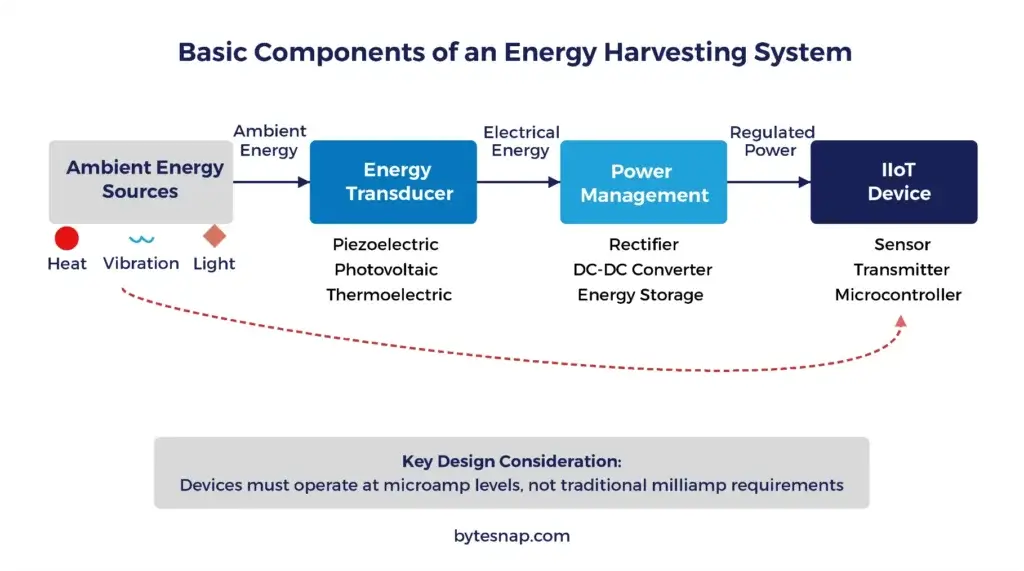
A typical system has three components:
- a transducer (captures energy)
- a power management circuit (regulates and stores it)
- and the target device (sensors, transmitters, etc.).
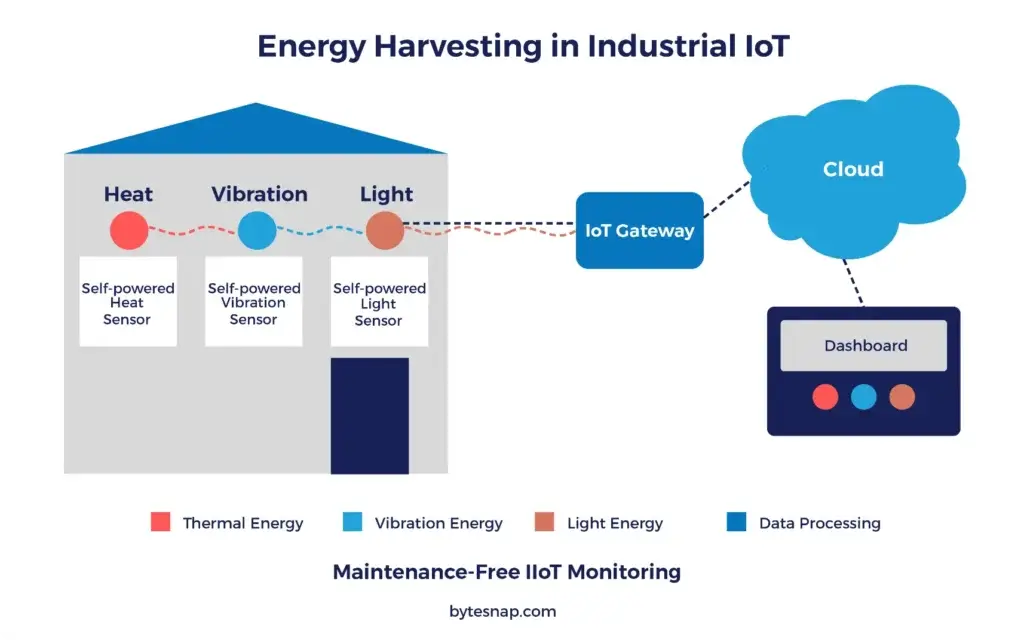
For IIoT deployments, energy harvesting eliminates the need for batteries or wired power. This matters most in remote or hard-to-reach locations where maintenance is expensive or impossible.
When paired with ultra-low-power electronics and efficient storage (supercapacitors or small rechargeable batteries), harvested energy can support years of continuous operation.
Benefits of Self-Powered IIoT Sensors
- Reduced maintenance costs – Battery replacements are expensive. A sensor on a remote pipeline or high up on manufacturing equipment might cost hundreds of pounds in labour, access equipment, or downtime. Energy harvesting eliminates that cost entirely
- Increased deployment flexibility – No power outlets? No problem. Self-powered sensors go anywhere: inside machinery, on moving parts, across wide-area facilities, or in hazardous zones where cabling is unsafe or impossible.
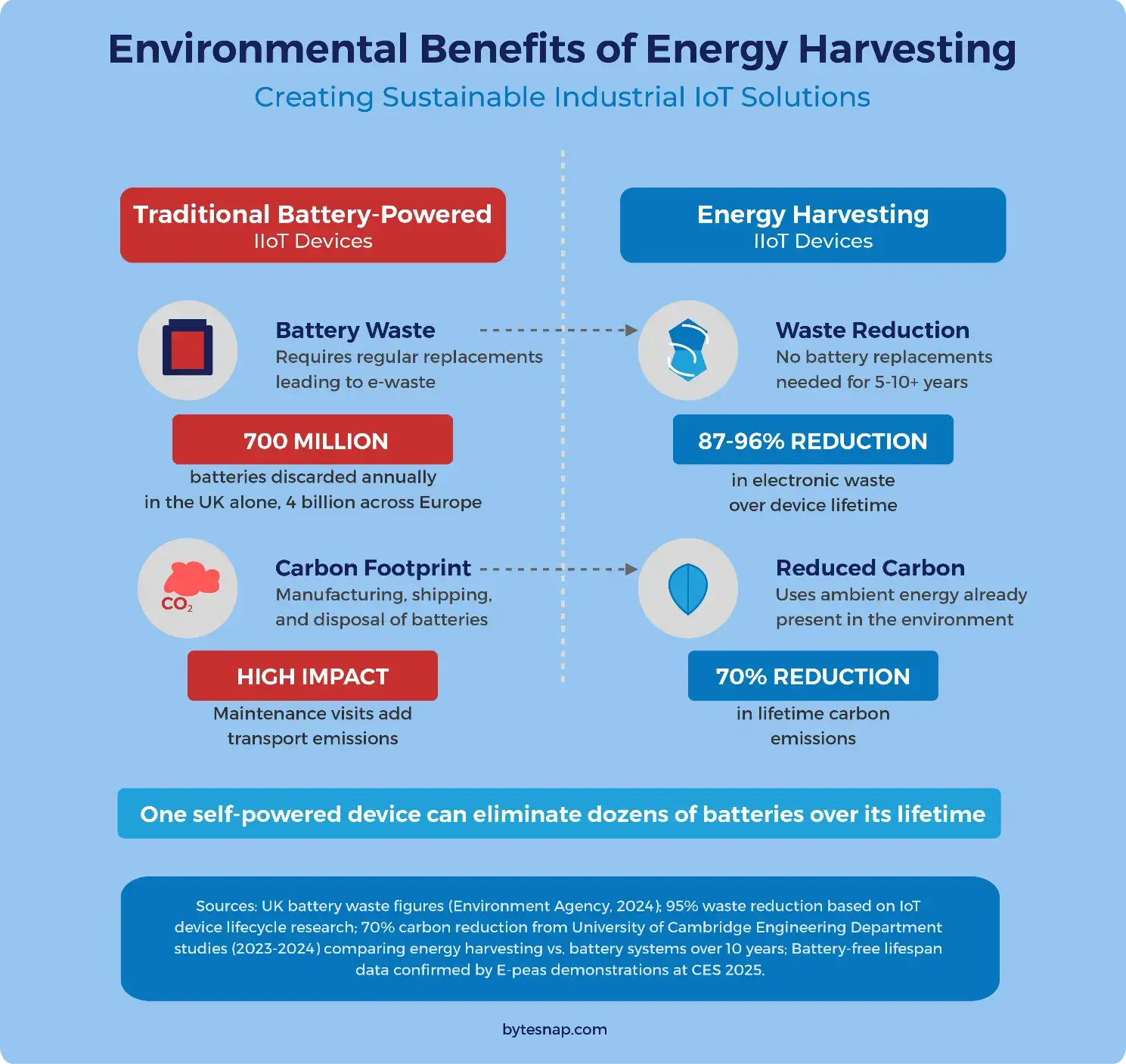
- Environmental sustainability – Fewer batteries mean less electronic waste. For large-scale IIoT deployments (thousands of nodes), the waste reduction is significant – and increasingly relevant under regulations like EU 2026/763.
- Enhanced reliability – A battery can fail unpredictably. An energy-harvesting device, properly designed, runs until its electronic components reach end-of-life – typically 10+ years. No midnight battery alarms.
- Cost-effective scalability – Adding 100 battery-powered sensors adds 100 maintenance schedules. Adding 100 harvesting-powered sensors adds zero. The upfront premium (15–30%) disappears in total cost of ownership (TCO) analysis within 1–2 years.
Before committing to an energy harvesting design, try ByteSnap Design’s free project calculator to assess your embedded project’s feasibility.
Ambient Energy Sources for IIoT
Vibration harvesting
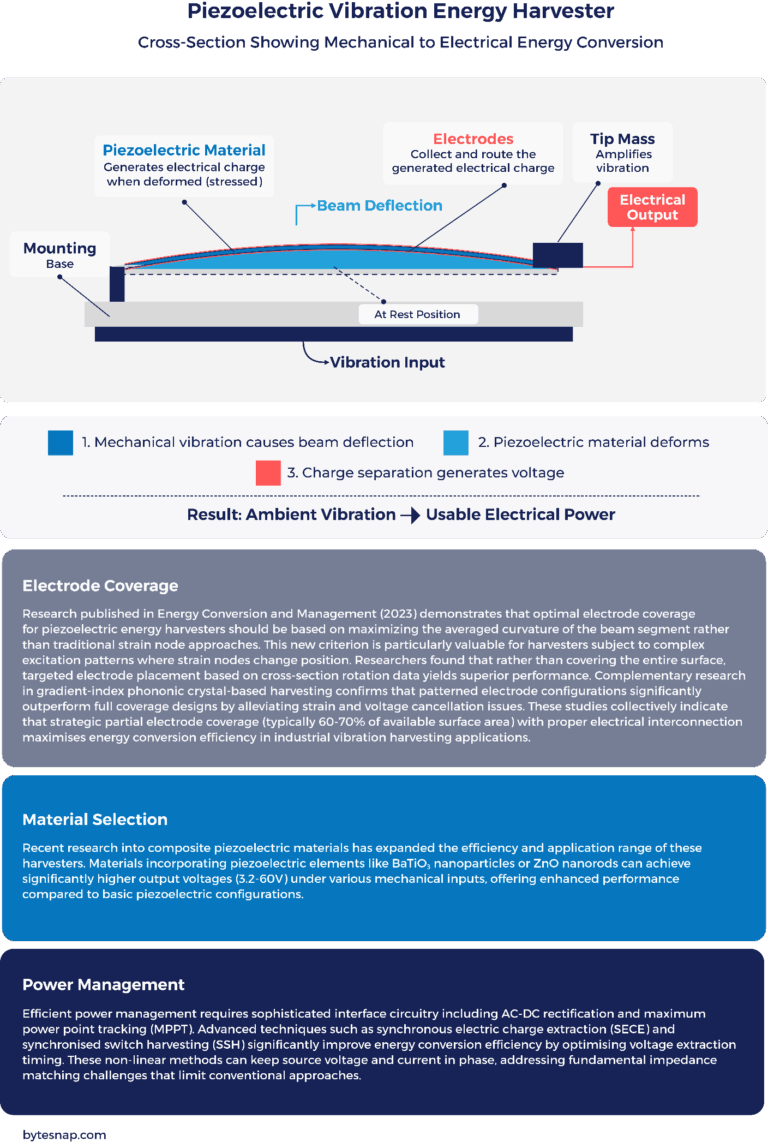
Industrial machinery generates consistent vibrations. Piezoelectric materials convert that mechanical energy into electrical power – generally 10–100 µW/cm³. Enough for intermittent sensor transmissions.
Example: A sensor attached to a conveyor belt motor can monitor temperature and runtime without batteries, waking only when vibration is present. ByteSnap’s industrial IoT solutions team has delivered similar deployments.
Thermoelectric (heat) harvesting
Thermoelectric generators (TEGs) use the Seebeck effect: temperature difference creates voltage. A differential as small as 5°C generates usable power, though industrial applications (furnaces, boilers, exhaust stacks) often provide 20–50°C gradients. Efficiency is low (5–10%), but the energy is free and constant.
Light (photovoltaic) harvesting
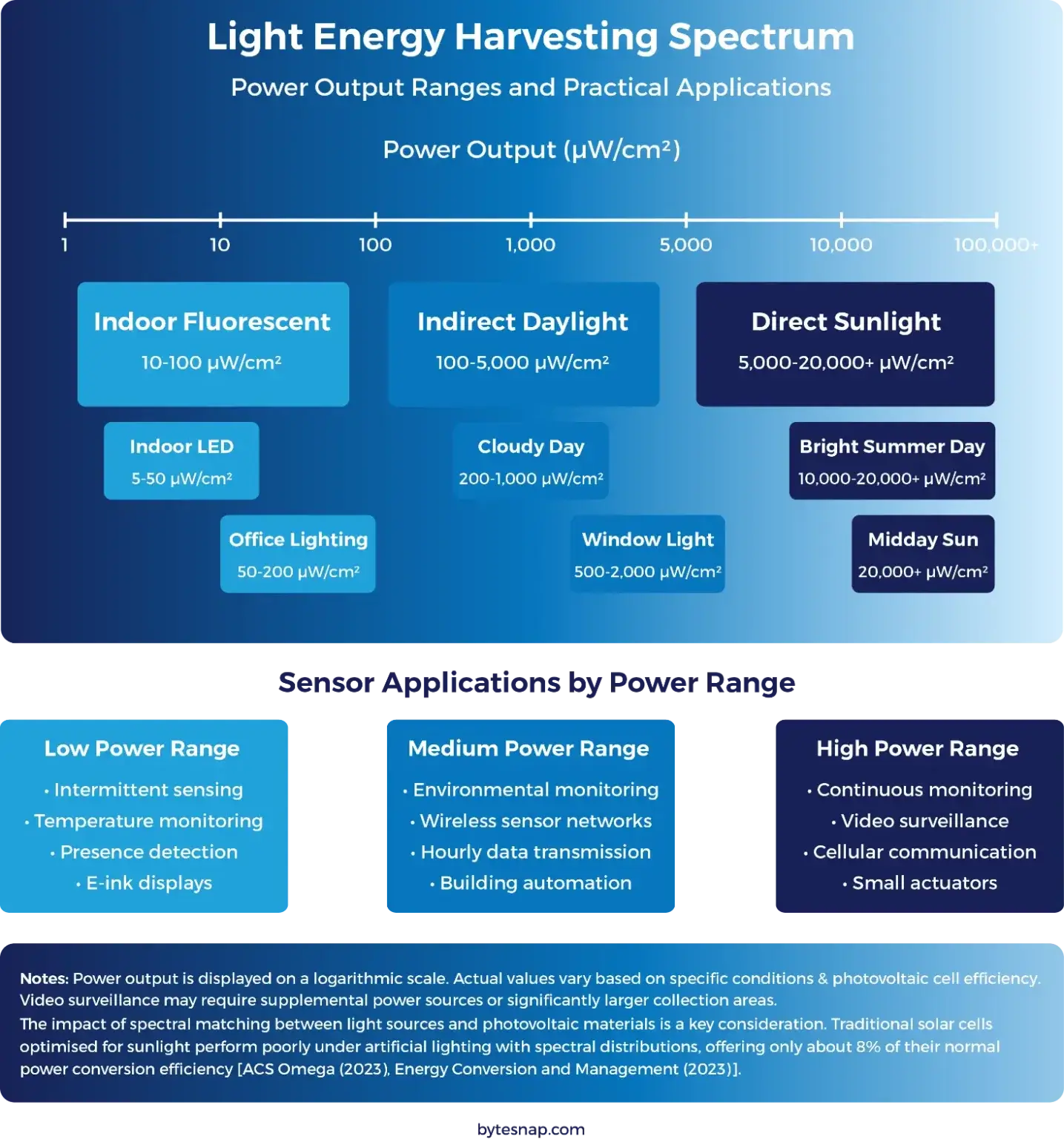
The most mature and widely deployed method. Outdoor solar delivers milliwatts to watts per cm² – enough for continuous operation. Indoor PV, traditionally 15–25% efficient under office lighting, now reaches 32–38% with commercial perovskite cells (2026).
Example: A warehouse occupancy sensor running on indoor light can transmit hourly readings indefinitely.
RF harvesting
Captures ambient radio waves (Wi-Fi, mobile networks, dedicated transmitters). Power levels are tiny (microwatts), but for ultra-low-power devices in high-RF environments (factories with dense wireless networks), it is viable. Not for repeated transmissions – but enough for a temperature reading every few hours.
Kinetic (motion/flow) harvesting
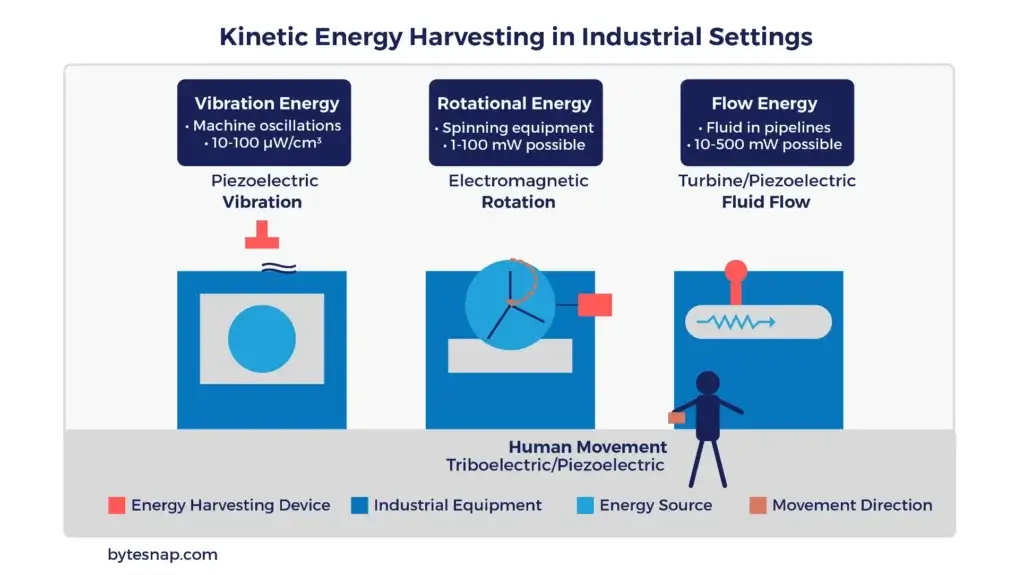
Beyond vibration: rotating shafts, fluid flow in pipes, even human movement. Electromagnetic or triboelectric generators (TENGs) convert this motion.
Example: A pipeline flow monitor powered by a small turbine integrated into the line – no batteries, no external power.
ByteSnap Design's Wireless IIoT Product Design for the Rail Industry
ByteSnap was commissioned to create a backup system for monitoring the integrity of railway signalling lines to create alerts in the event of failure.
As there are very strict rules about working close to railway lines, the system needed to run entirely from energy harvesting so that batteries didn’t need to be replaced, nor existing rail network power lines tapped into (which could have placed a risk on their integrity).
The system used sensors to measure signal transmission on the control lines and had a combination of three energy harvesting inputs – Piezo (to generate power from passing trains), solar and small wind turbines.
An Analog Devices ADP5091 with supercapacitor backup was used to power the LoRa pulse current and allow readings when energy could not be harvested directly (e.g. at night).
Engineering Challenges: Power Budgets, Storage, Efficiency
Power Requirements vs. Harvesting Capabilities
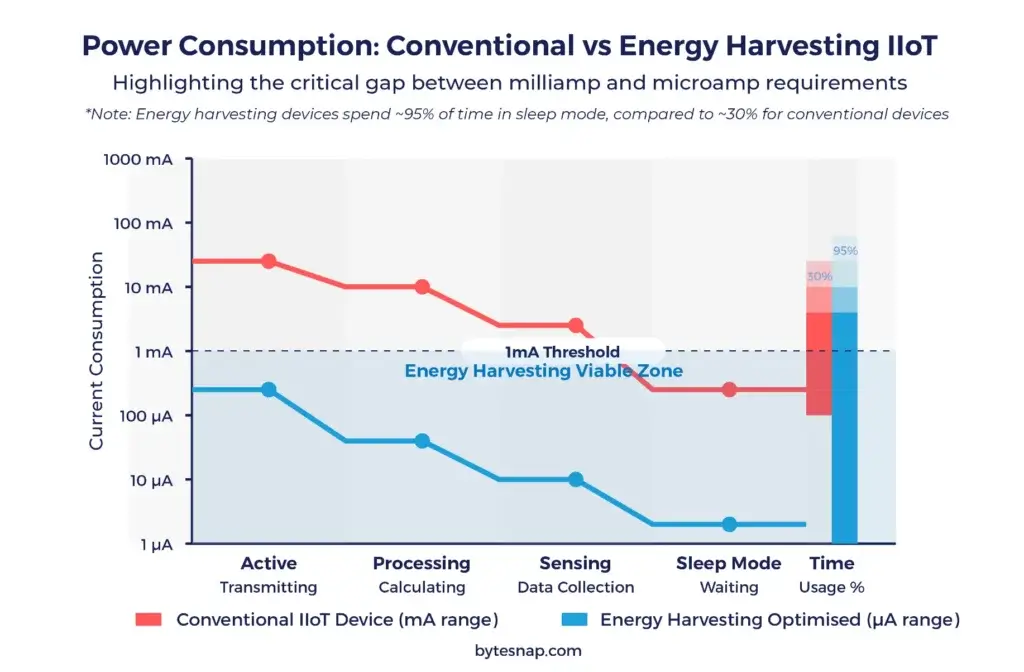
Many designs simply aren’t suitable for energy harvesting because they draw tens of milliamps or more under normal operating conditions.
Whilst this is feasible with a solar array, in many cases, the size or location does not allow for a large enough panel. Other forms of harvesting, e.g., piezo, RF and thermoelectric, are unlikely to be able to power such a device.
The first question, therefore, is whether energy harvesting is feasible for an application. If you’re trying to stream video over a 5G link, energy harvesting is very unlikely to be for you!
If your product uses microamps most of the time, with pulses in the milliamp range when transmitting, it could be a good fit.
Energy Storage
Energy harvesting doesn’t remove the need for energy storage in most cases. For instance, if you’re using a PV source but need to be able to operate in the dark, you’re going to need to store energy from the source when there is light available.
You’ll also need to size your storage and PV source such that it can provide enough energy to not only power the device during daylight but also have enough spare to run through the night.
Storage usually means either capacitors or batteries. The former are suitable for very low-power devices, and the latter for higher-power devices.
There are many types of batteries and capacitors, and this is outside the scope of this article. Suffice it to say that everyone who owns a mobile phone will understand that rechargeable batteries have their own finite lifespan and operating temperature range, and the same is true for capacitors.
Both need rating not only for the initial product life but also over the operating lifetime, which usually means overrating them.
Efficiency and Energy Conversion
Energy conversion efficiency remains a key requirement across all harvesting technologies. Current thermoelectric generators typically operate at only 5-10% efficiency, while indoor photovoltaic cells might achieve 15-25% efficiency under optimal conditions.
These limitations mean that harvesting systems must be carefully designed to maximise energy capture and minimise losses.
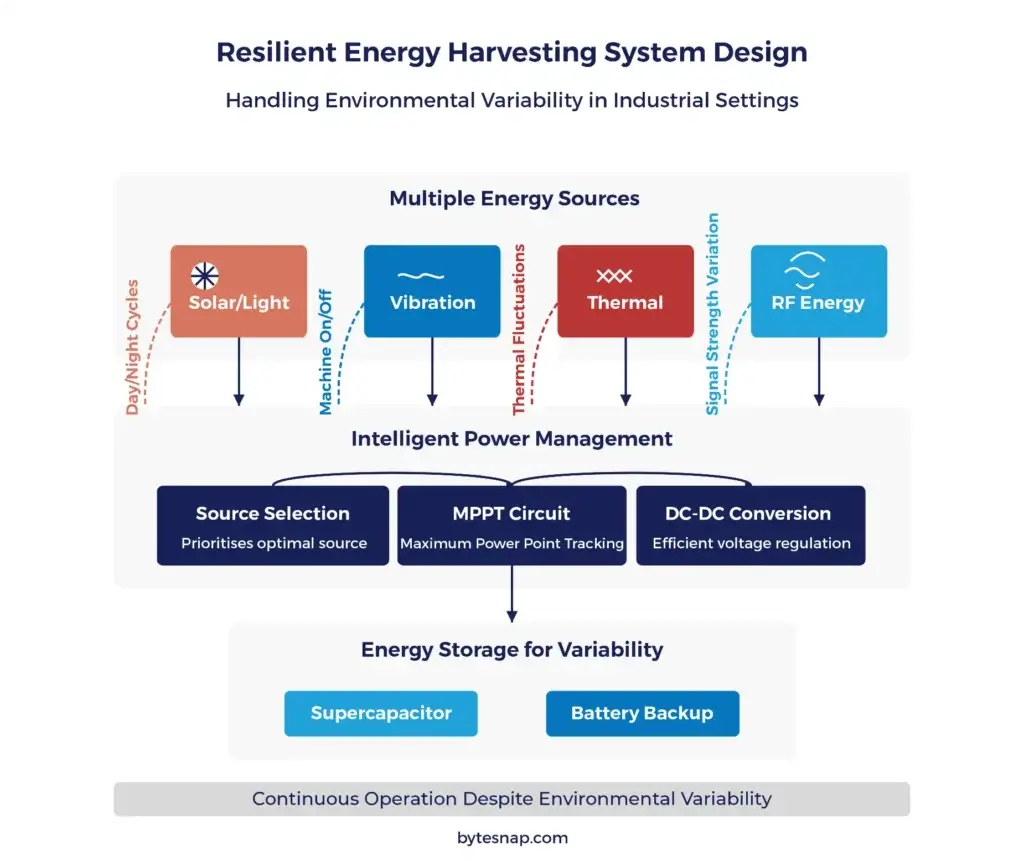
The power management circuitry plays a central role in optimising efficiency, as it must handle irregular and unpredictable energy inputs while maintaining stable power output.
Advanced power management integrated circuits (PMICs) specifically designed for energy harvesting applications have emerged, incorporating features such as maximum power point tracking (MPPT) and ultra-low-power DC-DC conversion to extract the maximum available energy from ambient sources.
Environmental Variability
Industrial environments are rarely stable, which poses challenges for energy harvesting systems that rely on consistent ambient energy sources.
Vibration-based systems may encounter machinery that operates intermittently, while light-based systems must contend with varying lighting conditions.
This variability necessitates robust energy storage solutions, such as supercapacitors or small rechargeable batteries, to ensure continuous device operation during periods when harvested energy is unavailable.
Ultra-low-power design
Creating truly self-powered IIoT devices requires a fundamental shift in design approach. Every aspect of the device must be optimised for ultra-low power consumption, including:
- Microcontrollers that support multiple deep sleep modes
- Sensors with low sampling power and rapid start-up times
- Communication protocols optimised for minimal transmission power
- Firmware designed to maximise sleep time while maintaining functionality
In many cases, this means rethinking data acquisition and transmission strategies.
Rather than continuous monitoring, energy-harvesting devices often employ event-based sensing or scheduled wake-up patterns to conserve energy while still delivering valuable insights. The software aspects of energy harvesting systems can be every bit as important as the hardware design in terms of creating a system that works in the real-world.
Size and Integration Constraints
Another practical challenge is the physical integration of energy harvesting components into IIoT devices.
Harvesting mechanisms often require specific positioning or orientation to maximise energy capture.
For example, vibration harvesters need to be aligned with the primary vibration axis, while photovoltaic cells require exposure to light sources. These requirements can conflict with other design constraints, particularly for devices intended for retrofit applications in existing industrial equipment.
Addressing these issues requires a holistic approach to device design, considering not just the energy harvesting mechanism, but the entire power architecture, from generation to storage to consumption.
Successful implementation demands collaboration between mechanical, electronic, and software engineers to create truly optimised solutions that can reliably operate in industrial environments for years without maintenance.
For deployments in hazardous environments, consult ByteSnap Design’s ATEX and hazardous area design team early in the project.
Energy Harvesting Feasibility: Calculation Method & Examples
Consider an example of an IoT device powered by ambient indoor light, that communicates over Zigbee. The ANYSOLAR KXOB25-02X8F is an efficient solar cell with an expected output of 2.5 mW of power in average office lighting for its 1.2 cm2 area.
Let’s assume that we have 10 cm2 of solar photovoltaics on our device, and our environment sees 10 hours of light per day. If we select an appropriately-sized energy storage component, such as a supercapacitor or rechargeable battery, then we can expect to be able to store 750 joules of energy per day.
For the Zigbee transmitter, we can use the SiLabs EFR32MG27 which is a microcontroller with an integrated 2.4 GHz radio. The sleep current of the device is less than 10 microwatts; however, any realistic IoT device would have additional quiescent power draws from the additional sensors and peripherals needed for it to perform its purpose.
We can estimate the average sleep power consumption of the system as 200 microwatts. A short Zigbee message suitable for IoT could last 5 seconds to transmit. Using these values, we can calculate that our indoor light-powered Zigbee device can connect to its network on average about 200 times per hour, powered entirely by ambient energy harvesting.
This calculations method can be used to estimate the performance of any combination of energy harvesting and wireless communications technology, in order to assess the viability of IoT concept devices.
The matrix below shows the average number of hourly transmissions possible for an IoT system using standard off-the-shelf electronics, and making similar assumptions for harvesting area and sleep power.
Average hourly transmissions by energy harvesting method and wireless protocol
Based on standard off-the-shelf electronics, 10 cm² harvesting area, 200 µW average sleep power
| Wireless Communications Method | |||||
|---|---|---|---|---|---|
| Zigbee | Bluetooth LE | LoRaWAN | NB Cellular | ||
| Energy Harvesting Method | Light (outdoor) | 1,000 | 7,200 | 370 | 19 |
| Light (indoor) | 200 | 1,400 | 73 | 4 | |
| Thermoelectric | 9 | 64 | 3 | 0.24 | |
| −15 dB ISM RF | 10 | 90 | 5 | 0.17 | |
Source: ByteSnap Design analysis. Figures represent average transmissions per hour under representative conditions. Outdoor solar provides the highest available power; NB Cellular is the most power-hungry protocol. Values below 1 indicate that continuous operation is not practical with these harvesting sources and protocols.
Energy Harvesting in IIoT: 2026 Market & Technology Update
Since late 2025, energy harvesting for IIoT has moved from emerging to deployable at scale. Here’s what has changed, and what it means for your product roadmap.
1 Perovskite indoor photovoltaics are commercially available
Perovskite-based indoor cells now achieve 32 38% efficiency under 200 500 lux LED (vs 15 25% for traditional a-Si). Multiple IEC-certified modules are shipping with >5 year lifetimes.
For designers: harvestable power per cm² has effectively doubled since 2024.
2 Triboelectric nanogenerators (TENGs) have industrialised
TENGs are now found in off-the-shelf vibration and flow-energy harvesters targeting machinery monitoring. They generate μW mW from low-frequency (<10 Hz) motion where piezos struggle. TENG + piezo hybrid modules are in 2026 distributor catalogues.
3 Hybrid harvesting is today’s baseline
Field deployments in 2026 routinely combine two or more sources: Indoor PV + thermoelectric (waste heat + light) Vibration (piezo/TENG) + RF All feeding a supercap + intelligent PMIC with dynamic source prioritisation.
4 AI-driven energy prediction is now a design requirement
Ultra-low-power inference (<10 μW) enables harvest-aware duty cycling. Devices learn their energy envelope (light patterns, vibration cycles, thermal gradients) and adapt sensing/transmission schedules in real time. 2026 chips from Ambiq, TI, and Alps Alpine include dedicated harvester-AI coprocessors.
5 Standardisation is complete
The IEEE P289x series (2025 2026) defines: Uniform test methods for intermittent power Interoperable energy buffer interfaces Energy harvestable labelling for industrial sensors
6 Energy harvesting as a service (EHaas) is live
Systems integrators now offer maintenance-free SLAs with harvested-powered sensors, paid per data point or uptime. For OEMs, this changes ROI from battery swap cost to zero-touch lifetime value .
7 Regulatory tailwinds: EU 2026/763
The updated Ecodesign for Remote Sensing mandates that new EU industrial wireless sensors must either:
- Use energy harvesting
- or Demonstrate a 10-year battery life with recyclable chemistry
Energy harvesting is now a compliance path, not a nice-to-have.
Summary for engineers: The physics hasn’t changed, but commercial availability, predictability, and tooling have. In 2026, you can design an energy-harvesting IIoT device with lower risk and faster time-to-market than ever before. The limiting factor is no longer feasibility it is system-level power architecture discipline.
Conclusion: Energy Harvesting vs Battery for IIoT Deployments
Energy harvesting represents a transformative approach to powering the Industrial Internet of Things, offering a pathway to truly autonomous sensing and monitoring systems that can operate indefinitely without maintenance.
While issues remain, particularly in matching power requirements with harvesting capabilities, the trajectory of technological development suggests that an increasing range of industrial applications will become viable for self-powered operation in the coming years.
As these technologies continue to mature, they will enable new deployment scenarios that were previously impractical due to power constraints, ultimately expanding the reach and impact of IIoT across industrial sectors.
The companies that successfully incorporate energy harvesting into their product strategies will gain significant advantages in terms of deployment flexibility, maintenance costs, and environmental sustainability.
Ready to validate energy harvesting for your IIoT product?
At ByteSnap Design, we specialise in developing innovative electronics and software solutions, including energy-efficient IIoT devices that leverage the latest energy harvesting technologies. Our team of experienced engineers will guide you through the complexities of designing self-powered systems that operate reliably in challenging industrial environments.
Tell us your power budget - we'll tell you if it's feasible
Energy Harvesting for IIoT FAQs:
How much power can typically be harvested from industrial environments?
The amount of power available varies a lot, depending on the energy source and environmental conditions. Vibration harvesters in industrial machinery might generate 10 100 microwatts per cubic centimetre. Indoor light harvesting typically yields 10 100 microwatts per square centimetre under standard lighting conditions, while outdoor solar can provide milliwatts to watts per square centimetre. Thermoelectric generators might produce 10 100 microwatts per square centimetre with a 10°C temperature gradient. These figures highlight why device design must focus on microamp-level power consumption rather than traditional milliampere ranges.
How long can energy harvesting devices operate without maintenance?
When properly designed, energy harvesting devices can operate for 10+ years without maintenance, limited primarily by the lifespan of electronic components rather than power sources. This contrasts with battery-powered devices, which typically require replacement every 1-3 years. The key is designing the entire system from harvesting mechanism to power management to application firmware with longevity in mind.
Are energy harvesting solutions cost-effective compared to battery-powered alternatives?
While energy harvesting components often increase the initial device cost by 15-30%, the total cost of ownership is generally lower when maintenance expenses are considered. For remote or hard-to-access locations, where battery replacement might cost hundreds of pounds in labour and downtime, self-powered devices can provide a return on investment within 1-2 years. The business case becomes stronger as deployment scale increases.
What communication protocols are best suited for energy harvesting IIoT devices?
Low-power wireless protocols like LoRaWAN, Zigbee, and Bluetooth Low Energy are well-matched to energy harvesting constraints. These protocols support efficient sleep modes and minimise transmission times. LoRaWAN is particularly suitable for industrial applications due to its long range and extremely low power consumption, with devices able to operate for years on minimal energy budgets. The choice ultimately depends on range requirements, data throughput needs, and network infrastructure.
Can energy harvesting power continuous monitoring applications?
Continuous high-frequency monitoring remains challenging for most energy harvesting applications. However, many industrial scenarios don’t require continuous data; instead, samples taken at appropriate intervals (minutes, hours, or event-triggered) provide sufficient insights. Alternatively, hybrid approaches using small rechargeable batteries or supercapacitors alongside energy harvesting can support brief periods of higher-power operation while maintaining long-term maintenance-free benefits.

Dunstan is a chartered electronics engineer who has been providing embedded systems design, production and consultancy to businesses around the world for over 30 years.
Dunstan graduated from Cambridge University with a degree in electronics engineering in 1992. After working in the industry for several years, he co-founded multi-award-winning electronics engineering consultancy ByteSnap Design in 2008. He then went on to launch international EV charging design consultancy Versinetic during the 2020 global lockdown.
An experienced conference speaker domestically and internationally, Dunstan covers several areas of electronics product development, including IoT, integrated software design and complex project management.
In his spare time, Dunstan enjoys hiking and astronomy.
Expand your knowledge
Huang, S. et al. (2026). Multimodal Strategy for Efficient Semi-Transparent Perovskite Solar Cells and Modules with Record Indoor Performance. Advanced Energy Materials. DOI: 10.1002/aenm.202505931
Wang, L. et al. (2026). Compact double-layer wind-driven triboelectric nanogenerator for internet of things sensors. Energy Conversion and Management. View paper
Jahanbazi, S. et al. (2026). MDP-based Energy-aware Task Scheduling for Battery-less IoT. arXiv:2510.23820. Read on arXiv
LoRa Alliance (Feb 2026). Powering the Future: How Energy Harvesting and LoRaWAN Enable Battery-Free AI Vision. Download whitepaper
A self-powered microsystem with efficient power management for continuous wireless sensing. Microsystems & Nanoengineering 12, 178 (2026). Read article
Energy Harvesting Market Report – MarketsandMarkets