
AI in electronics: widely used, rarely trusted to decide

Share:

⏩ TL;DR

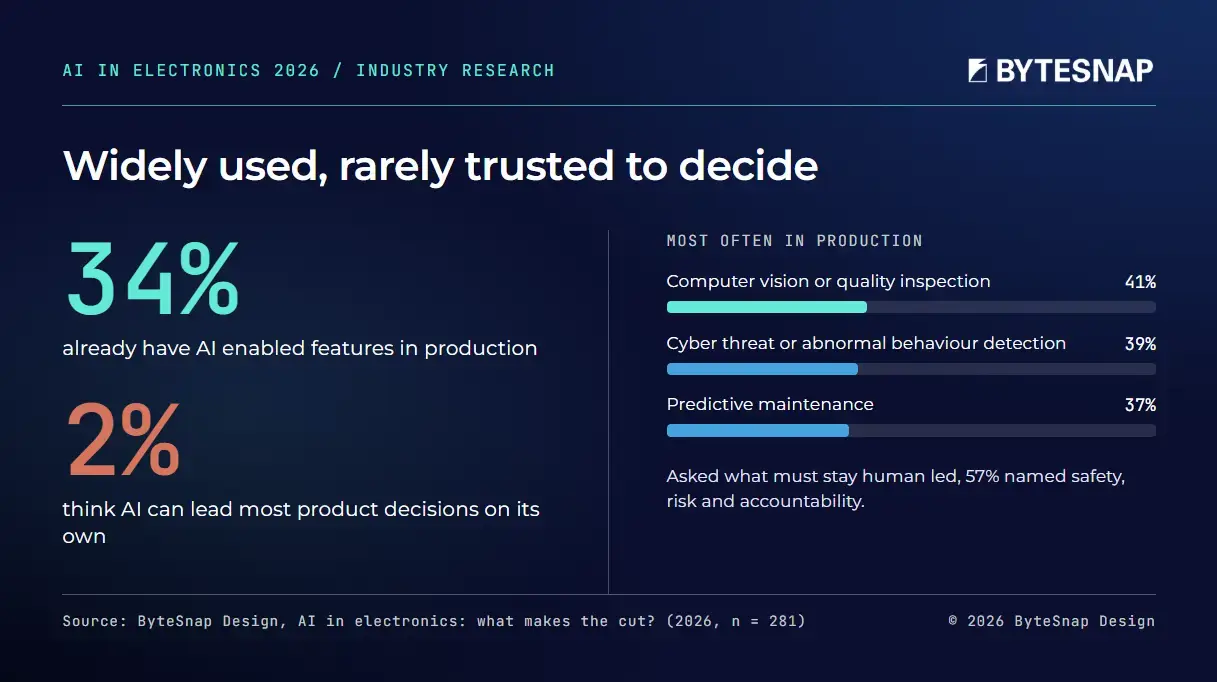
ByteSnap Design surveyed 281 UK electronics and embedded professionals in 2026. 34% already have AI features in production, but only 2% think AI can lead most product decisions on its own, and 57% say safety and accountability must stay human led. Integration with existing electronics is the biggest obstacle for the third year running (47%), and 33% say AI is adding verification work.

AI is already built into a large share of UK electronic products. Very few of the engineers building them will let it make product decisions on its own. That’s the headline from our latest survey of UK electronics and embedded professionals. The full report, AI in electronics: what makes the cut? by Dunstan Power, is available to download.

High adoption, almost no autonomy

34% of respondents have AI-enabled features in production, and a further 26% are running pilots.
 
Only 2% think AI can lead most product development decisions on its own, and 57% say safety, risk acceptance and accountability must stay human-led.
 
The AI furthest into production does narrow jobs: computer vision and quality inspection (41%), cyber threat detection (39%) and predictive maintenance (37%).
 
These systems watch for a known pattern and flag it. The judgement stays with an engineer.

Integration has topped our survey three years running

We have asked about the biggest obstacle to AI in each of our last three surveys, worded differently each time, and integration has come out on top every year.
 
Hover over each row for the detail.
Source: ByteSnap Design, AI in the workplace (2024), Future proofing manufacturing (2025), AI in electronics: what makes the cut (2026, n = 301). Questions were not worded identically across years, and 2025 allowed multiple answers.
YearSurveyQuestion askedTop finding
2024AI in the workplaceBiggest challenge deploying AIIntegration with existing systems and workflows, 34%
2025Future proofing manufacturingMain challenges managing obsolescenceIntegration with existing systems, 62%
2026AI in electronics: what makes the cutBiggest snag moving AI from concept to productIntegration with existing electronics, firmware or control logic, 46%
The scarce skill, according to the engineers we surveyed, is making a working AI feature live inside a product that already has firmware, control logic and certification history behind it.
 
That is systems engineering rather than data science.

Whose time is actually being saved?

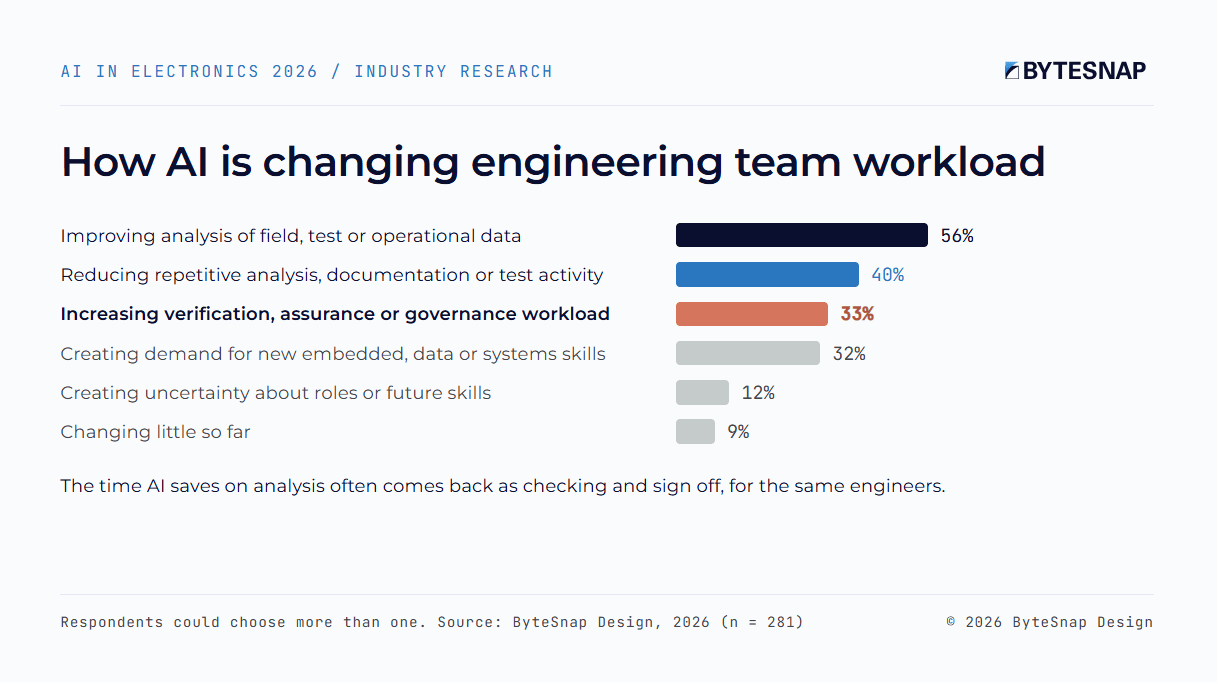
40% agree that AI is cutting their repetitive tasks, while 33% say it is adding verification and governance work.
 
Often, these are two halves of the same trade, landing on the same engineer.

40% of engineers say AI is saving them time. A third say it is adding verification and governance work. On the projects we see, both land on the same engineers. If the business case only counts the saving, the programme pays for the verification later, usually close to release.

Get the full report

The survey report goes further the findings and covers what the mean for engineering teams:

Download "AI in Electronics: What Makes the Cut?"

Michelle Robinson

Michèlle Robinson is Head of Marketing at ByteSnap Design, the UK embedded systems and electronic design consultancy, and at its EV charger design subsidiary, Versinetic.

She joined ByteSnap Design in 2014 and has written about embedded systems and electronics product development ever since.

Michèlle came to technology from broadcast journalism. She’s worked as a news reporter, sub-editor, correspondent and presenter across UK television and radio, including BBC 5 Live, BBC Radio 4, BBC Breakfast News, ITV Central, Westcountry TV, and both BBC and independent local radio.

She writes on embedded design, AI in electronics, product development and trends across the UK electronics sector.

Outside work, Michèlle travels, learns languages and practises hot yoga.
Share:

Related Posts

50p piece next to PCB boards_(c) ByteSnap Design
Bluetooth 6 - Illustration (2)