⏩ TL;DR: Bluetooth 6 Channel Sounding vs RSSI
Bluetooth 6 channel sounding replaces RSSI's signal-strength guesswork with an actual measurement of distance, combining Phase-Based Ranging and Round-Trip Time. The Bluetooth spec publishes accuracy figures for clean, open conditions, but the honest picture is more complicated. Vendor reference algorithms are built to demonstrate the technology, not to handle the reflections, metal, and clutter of a real site, and getting from a working demo to a reliable product means doing real signal processing on top of what the chipset vendor ships. It also needs new Bluetooth 6 silicon, not a firmware update to existing 5.x hardware.
Table of Contents
Bluetooth has become the default radio in most connected products. Bluetooth 5.x already brought longer range, higher throughput, and direction finding for teams who needed it. Bluetooth 6 adds something different: channel sounding, a method built specifically for high-accuracy distance measurement.
If you’re evaluating this for a product, forget the spec sheet for a second. The real question is whether you can get reliable, workstation-level tracking in your actual environment, at a BOM and power budget that works for your product.
How Bluetooth location has worked until now
RSSI-based ranging, the approach most teams have used since Bluetooth 4, is simple and cheap.
It’s also unreliable once you leave a clean lab environment. Signal strength drifts by several metres in real conditions, and it’s highly sensitive to multipath reflections, people walking through the signal path, and metal surfaces.
Plenty of teams have tried it, found it “sort of worked on paper,” and then hit a wall trying to get tight geofencing or workstation-level accuracy out of it.
Direction finding, using angle of arrival or angle of departure, introduced in Bluetooth 5.1, improved relative positioning through antenna arrays and angle estimation. It also adds hardware complexity through antenna arrays and calibration, and it’s still challenged in dense, reflective spaces.
Bluetooth 6’s channel sounding is the first time the spec has put high-accuracy distance at the centre of the story, rather than bolting a workaround onto RSSI or angle estimation.
What is Bluetooth 6 channel sounding?
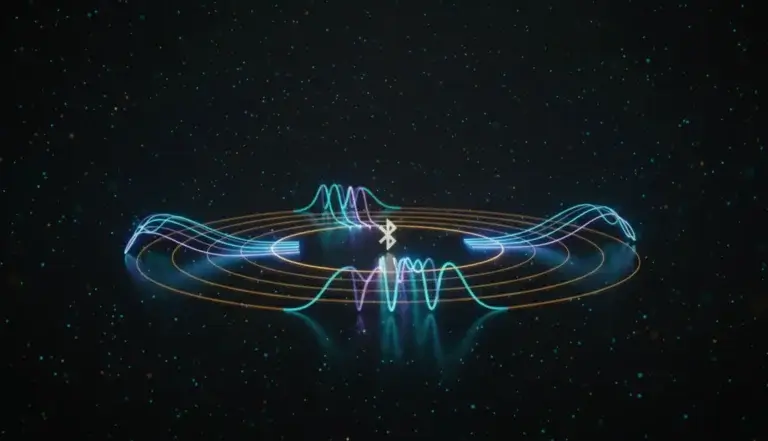
At a high level, two devices, an initiator and a reflector, exchange known signals and measure how those signals were altered by the environment.
From this, the system derives distance directly using two complementary methods, covered in full in the Bluetooth SIG’s Channel Sounding overview:
- Phase-Based Ranging (PBR) measures phase shifts across up to 72 channels in the 2.4GHz band to calculate distance with precision.
- Round-Trip Time (RTT) measures how long a signal takes to travel to the other device and back.
You can use the two methods together. When they are, an inconsistency between them signals that something, or someone, is interfering with the measurement.
It’s part of why channel sounding also improves resistance to relay-attack spoofing compared with older Bluetooth ranging.
RSSI answers “how loud is this signal?”
Channel sounding answers “how did this signal actually travel?”
That’s a different, and far more useful, question for location work. It’s why channel sounding is much less fooled by someone walking between two nodes, or by reflections off stainless steel, machinery, or concrete.
Why a phase reading alone isn't the whole answer
Phase-Based Ranging works by measuring how a signal’s phase shifts across a sweep of frequencies. The catch is that phase repeats every wave cycle, so a distance of, say, ten centimetres and a distance one full cycle further away can produce an identical phase reading. On its own, PBR can’t tell them apart.
It’s why Round-Trip Time matters as a companion measurement rather than a fallback. RTT is coarser, but it’s not ambiguous in the same way, and combining the two lets the system rule out the wrong answer.
Filtering out incorrect results is one of the places specialist signal processing earns its keep.
A reference algorithm that only looks for the first, strongest peak in the reflected signal can get this wrong in exactly the cluttered, reflective environments most real deployments live in.
What can you actually build with this?
Regarding accuracy, the Bluetooth spec publishes figures for clean, line-of-sight conditions.
What you actually get out of a reference algorithm on a cluttered desk, with reflections off screens, equipment, and metal surfaces, is a different story, and it’s a big enough gap that treating a spec-sheet figure as a design guarantee is a mistake.
Real performance depends on antenna design, the environment, and critically, the signal processing sitting between the raw channel data and the distance figure your product reports.
That last part is where a vendor’s out-of-the-box example and a production-ready system diverge most.
A few concrete examples come up repeatedly with clients:
Tool and asset tracking in RF-hostile environments
Stainless steel, steam, and moving people make RSSI-based tracking close to useless in a commercial kitchen or a factory floor. The question teams actually need answered, "is this tool at this station right now," is what channel sounding is built for.
Fine-grained fixture or component verification
- where sub-centimetre confirmation is needed, is UWB territory. Channel sounding isn't built for that level of precision.
Safety-adjacent use cases:
Location-based interlocks and zone enforcement, used as one input into a broader safety architecture rather than the sole safeguard.
Battery-powered ATEX devices
Our own ATEX product design work already grapples with tight power budgets, and channel sounding's lower power draw compared with UWB is a real advantage for hazardous-area tags that need to last years on a battery.
We’ve seen this pattern show up in real enquiries this year.
One recent example: a client wanted to track sensitive equipment across an office environment, a use case that simply wasn’t practical with RSSI-based tracking and would have been overkill for UWB. That’s a fairly ordinary example of the gap channel sounding is starting to fill.
ByteSnap Design has been building Bluetooth into physical products for the better part of two decades. Our Bluetooth-based lab monitoring design for White Horse Scientific is a good example of the hardware, firmware, and app-level discipline that carries over into channel-sounding projects, even though that particular product predates Bluetooth 6.
What changes in your design
You need silicon and firmware that fully support channel sounding, not just Bluetooth 6 in general. Antenna design and placement matter more than with RSSI, since the system is more sensitive to clock timing and RF layout quality. Enclosure materials, device orientation, and ground plane all affect real-world accuracy.
If you’re already deep into low-power wireless design, this is the same discipline applied to a more demanding measurement. It also has to coexist with ordinary BLE data connections and, in most products, Wi-Fi, so scheduling and channel management matter more here than in a typical BLE product.
On the firmware side, decisions on when to run ranging exchanges, how to manage power against update rate, and how to handle missed packets and outliers all sit on top of your existing RTOS task structure. Teams with WirelessHART or other industrial protocol experience will recognise the general shape of this problem, even though the underlying protocol is different, as we discuss in WirelessHART vs HART.
At system level, topologies generally run tags on assets against fixed anchors or gateways, feeding a backend. Where you do the processing – on-device, at the gateway, or in the cloud – is a real design decision, not a default.
Security is worth getting right here too. RTT exchanges run over an encrypted connection, and the dual PBR/RTT approach already gives some built-in resistance to spoofing, as covered in Part 1.
What still needs proper engineering attention is making sure that security is configured and validated correctly for your specific deployment, not assumed, the same rigour we’d apply to any secure OTA firmware architecture.
When is channel sounding not the right tool?
If all you actually need is room-level presence detection, or rough “in the building or not” proximity, channel sounding is over-engineering.
If your BOM and power budget genuinely can’t stretch beyond the cheapest BLE beacons, or if your product’s enclosure or environment makes good antenna design impossible, stick with simpler Bluetooth 5.x approaches, or look at whether UWB is a better fit for your accuracy requirements.
Channel sounding is powerful. It’s not a fit-all hammer – and a design partner who tells you otherwise isn’t doing you any favours.
Where this Bluetooth 6 series goes next
Bluetooth 6’s headline difference for product teams is channel-sounding-based distance measurement. It can turn previously marginal or impossible location use cases into realistic ones, if the system around it is designed properly.
In Part 2, we’ll walk through the architecture decisions that go into a real Bluetooth 6 channel-sounding system.
Evaluating Bluetooth 6 channel sounding for your product?
Bluetooth 6 Channel Sounding vs RSSI FAQs
How does Bluetooth 6 channel sounding differ from BLE RSSI?
RSSI measures signal strength only, which fluctuates when people move or radio waves bounce off metal or concrete. Channel sounding measures the actual phase and time-of-flight characteristics of the signal, giving a direct physical measurement of distance rather than an estimate based on how much the signal has faded.
Does channel sounding require Bluetooth 6?
Yes. It’s introduced specifically in the Bluetooth 6.x Core Specification, so both devices in a ranging exchange need channel-sounding-capable hardware. It isn’t available as a firmware update to Bluetooth 5.x silicon.
What ranging accuracy can product teams realistically expect?
Real-world performance depends heavily on antenna design, hardware layout, and environmental multipath. It consistently outperforms RSSI, but vendor reference algorithms are built for clean conditions, not cluttered real sites, so treat spec-sheet figures as a starting point for testing, not a guarantee.
What's the difference between PBR and RTT?
Phase-Based Ranging measures phase shifts across multiple Bluetooth channels for high precision over shorter distances. Round-Trip Time measures how long a signal takes to travel to the other device and back, giving coarser but unambiguous results. Used together, they cross-check each other and help protect against spoofing.
Does channel sounding require new hardware?
Yes. It needs a new physical layer that older Bluetooth 5.x chips don’t have. You can’t add it to existing silicon through a firmware update alone.

Liam O’Donnell is a Senior Software Engineer at ByteSnap Design. With over 18 years in embedded systems and microcontroller development, he works across firmware, industrial wireless protocols, and connected device design. He has implemented systems across oil and gas, petrochemical, and industrial automation facilities. Liam has a particular interest in the engineering decisions made early in a project that determine whether the field deployment goes smoothly or doesn’t.